Commercial Alarm Response Protocol: A Clear Plan
October 15, 2026
How to Upgrade Commercial Security Systems
October 16, 2026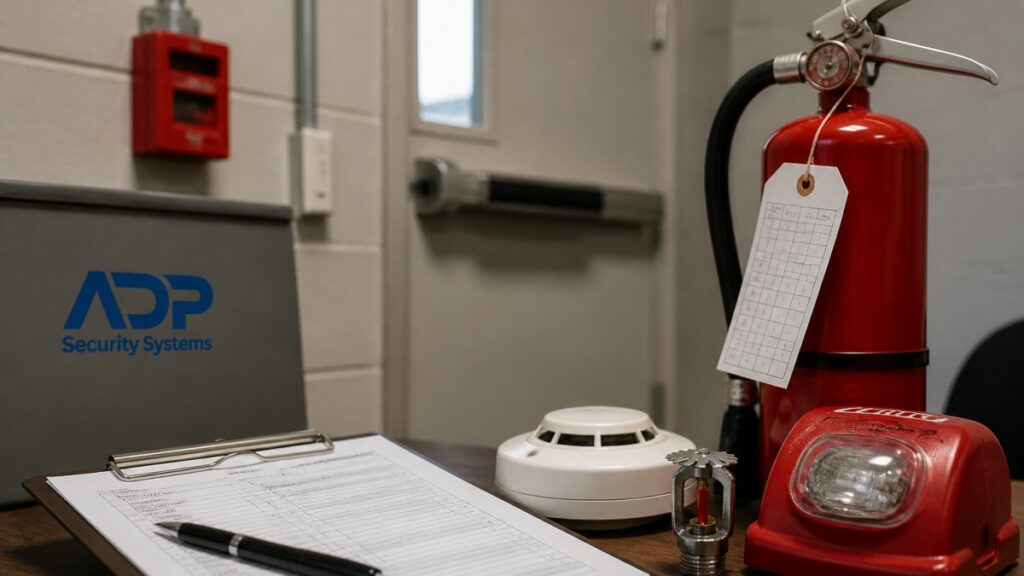
Table of Contents
- Why Fire Code Violations Happen in South Carolina Businesses
- The Most Common Fire Safety Violations in South Carolina Businesses
- Your Commercial Fire Inspection Checklist
- Commercial Fire Alarm Inspection Requirements
- Fire Extinguisher Inspection Requirements for Businesses
- Fire Safety Violations and Penalties for Businesses
- How to Prepare for a Fire Inspection and Avoid Violations
- Frequently Asked Questions
Last Updated: October 14, 2026
Why Fire Code Violations Happen in South Carolina Businesses
Most fire code violations in South Carolina businesses start small. A box set down in a hallway. A propped-open door. A dead battery in an exit sign.
Then an inspector walks in, and those small things become citations.
The South Carolina Fire Code is built on the International Fire Code, which the state adopts and local fire departments enforce. The rules exist for one reason: life safety. When a building catches fire, people have minutes to get out. Blocked paths and dead alarms cost lives.
At ADP Security Systems, we’ve spent more than 30 years installing and maintaining fire and life safety systems across the state. We’ve seen the same violations come up again and again.
The most common fire safety violations are not exotic code problems. They are everyday habits: blocked exits, locked doors, dead emergency lights, and missed inspections.
The Most Common Fire Safety Violations in South Carolina Businesses
Fire safety violations cluster into four groups: blocked exits, locked doors, failed emergency lighting, and neglected extinguishers or sprinklers. Here’s what each one looks like in practice.
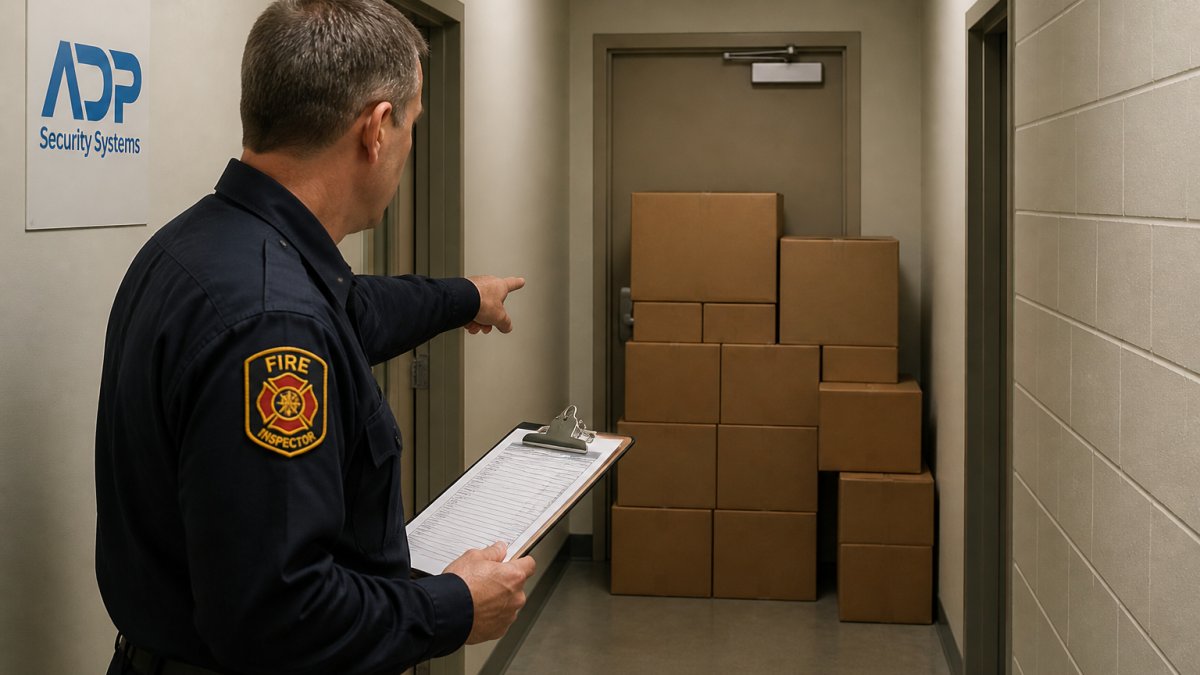
Blocked Exits and Obstructed Egress Paths
An exit path must stay clear at all times, not just during business hours. Stacked inventory, rolling carts, and trash bins are the usual culprits.
A blocked exit is one of the easiest violations to fix and one of the most dangerous to ignore. During a fire, smoke fills a room in seconds. If your path is blocked, people panic.
Walk your exits weekly. If you can’t move through at full speed, clear it.
Locked or Difficult-to-Open Exit Doors
Exit doors must open without a key, special knowledge, or effort. Chains, padlocks, and deadbolts on egress doors are all violations.
The reason is simple: in an emergency, people push, they don’t search. A door that needs a key is a door that traps people.
Check every exit door monthly. Push it open. If it fights back, fix the hardware.
Failed Emergency Lighting and Missing Exit Signage
Emergency lights and exit signs must work during a power outage. A dead battery means the sign goes dark exactly when people need it most.
Test your emergency lights monthly with the test button. Replace batteries as needed. Check that exit signs point the right way and stay lit.
Fire Extinguisher and Sprinkler System Problems
Extinguishers need a clear tag, the right pressure, and an annual service check. Sprinkler heads must stay clear of storage and paint.
A blocked, painted, or damaged sprinkler head won’t spray when it matters. Keep at least 18 inches of clearance below every head.
Storing boxes within 18 inches of a sprinkler head can stop the spray pattern and turn a small fire into a total loss. It’s also an automatic citation.
Your Commercial Fire Inspection Checklist
Use this checklist to find problems before an inspector does. Run through it monthly, and again the week before any scheduled inspection.
| Area | What to Check | How Often |
|---|---|---|
| Exits | Clear path, no storage | Weekly |
| Exit doors | Open freely, no locks | Monthly |
| Emergency lights | Test button works | Monthly |
| Exit signs | Lit and pointing correctly | Monthly |
| Extinguishers | Tag current, gauge in green | Monthly |
| Sprinklers | 18 inches clear below heads | Monthly |
| Alarm system | Panel shows no trouble | Monthly |
| Documentation | Inspection reports on file | Ongoing |
This list covers the basics. Your occupancy type may add more requirements. A restaurant kitchen, for example, has different rules than a warehouse.
Commercial Fire Alarm Inspection Requirements
A fire alarm system is not one inspection. It is three separate obligations that inspectors treat differently: inspection, testing, and maintenance. Confusing them is one of the most common reasons a business thinks it is current when it is not.
- Inspection, a visual check of devices, wiring, and the panel for damage, obstruction, or tampering.
- Testing, operating each device and circuit to confirm it actually functions.
- Maintenance, repairing or replacing anything that fails inspection or testing.
The National Fire Protection Association publishes the schedule most jurisdictions follow through NFPA 72, the National Fire Alarm and Signaling Code. The state adopts the International Fire Code, which references NFPA 72 for alarm system inspection, testing, and maintenance. That is the chain an inspector is citing when they write you up.
The Testing Cadence in Plain Terms
- Monthly: Inspect the panel for trouble signals, verify the system is in normal supervisory mode, and confirm the batteries and chargers are intact. This is a visual and functional check your own staff can often perform.
- Quarterly: Test waterflow devices, supervisory devices, and valve tamper switches on sprinkler-connected systems.
- Semi-annually: Test the initiating devices and notification appliances on a rotating schedule so the full system is exercised over time.
- Annually: A full system test by a qualified technician, including all initiating devices, notification appliances, and the off-premises transmission of signals to a monitoring center.
- Documentation: Every inspection and test produces a record. Keep them on file and available for the inspector.
The Recordkeeping Rule That Trips People Up
The test record is not optional. Inspectors look for the completed inspection and testing form, the date, the person who performed the work, and any devices that failed or were bypassed. A system that passes every device but has no paperwork is, for enforcement purposes, an untested system.
Impairments and the Notification Requirement
When a system is taken offline for repair, testing, or renovation, that is an impairment. NFPA 72 and the adopted fire code require that the building owner or the servicing contractor notify the fire department and the monitoring company before the system is disabled, and that a fire watch be posted if the system will be down beyond a set period. Skipping that notification is a violation on its own, separate from whatever caused the impairment.
Get a Free Security Assessment →
Schedule your annual test at least 30 days before your inspection calendar date. If a device fails, you want time to repair and retest before the inspector arrives, not after.
Why This Matters Beyond the Citation
A missed alarm inspection is a violation. It is also a common reason an insurer denies a claim after a fire, the policy requires the system be maintained in accordance with the applicable code, and an expired test record is evidence it was not. We build maintenance schedules around these intervals so the testing, the repairs, and the paperwork stay current together.
Fire Extinguisher Inspection Requirements for Businesses
Every extinguisher needs a monthly visual check and a professional service each year. The monthly check is something your own staff can do.
Look for:
- The gauge needle sitting in the green zone
- A current inspection tag
- No dents, rust, or damage to the canister
- A clear, unobstructed location
Professional service involves a deeper look at the internals. Only a trained technician should do that part.
Write the date and your initials on the tag after each monthly check. Inspectors look for that paper trail first, and a missing log is an easy citation.
Fire Safety Violations and Penalties for Businesses
Penalties in this state are not set by a single statewide fine schedule. They flow from three layers: the adopted code, the enforcing fire department, and the property’s occupancy classification.
The code layer. The state adopts the International Fire Code as the basis for its fire code, with amendments.
The enforcement layer. Local fire departments and the State Fire Marshal’s office carry out inspections and issue notices.
The occupancy layer. A high-hazard occupancy, a commercial kitchen with a hood suppression system, a repair garage with flammable storage, an assembly space over a posted occupant load, draws more scrutiny and shorter correction windows than a low-hazard office suite.
What a Notice Actually Looks Like
Most violations do not start as a fine. They start as a written notice that identifies the code section, the location, and a correction deadline. The typical sequence:
- Inspection, the inspector documents the condition and cites the applicable code section.
- Notice of violation, you receive the finding and a correction window.
- Correction, you fix the condition, often with documentation (a service invoice, a reinspection request).
- Reinspection, the inspector returns to verify. This is where a missed deadline becomes a penalty.
- Escalation, if the condition persists, the department can issue a citation, assess a civil penalty, or in serious cases order the building vacated until it is safe.
The Distinction That Matters: State vs. Federal
Federal enforcement is a different track. OSHA’s fire safety and exit-route standards (29 CFR 1910.36 and 1910.37) apply to most private employers regardless of what the local fire marshal does. That means a business can pass a municipal fire inspection and still face an OSHA citation for the same blocked exit or locked door. The two systems do not coordinate, and passing one does not satisfy the other.
Correction, Reinspection, and Appeals
If you disagree with a finding, the path is usually through the code official who issued it, a written request for reconsideration or a formal appeal to the board of appeals, depending on the jurisdiction. The window to appeal is short and typically runs from the date of the notice, not the date you get around to reading it. Missing the appeal window means the finding stands.
A citation that follows the property record can surface during a sale, a lease negotiation, or an insurance underwriting review. The fine is often the smallest cost of an unresolved violation.
The worst outcome is not the penalty. It is the liability exposure after a fire, when your inspection file shows a documented violation and an expired correction deadline.
How to Prepare for a Fire Inspection and Avoid Violations
Preparation is a routine, not a scramble. The businesses that pass cleanly are the ones that treat fire safety as a weekly habit.
Build these into your operation:
- Assign one person to own fire safety
- Run the monthly checklist above
- Keep a binder of every inspection and service report
- Fix small issues the day you find them
- Schedule professional testing before the deadline, not after
If your alarm or sprinkler system is aging, get ahead of it. Replacing failing equipment on your schedule beats an emergency repair after a citation.
For businesses in Greenville, Spartanburg, Anderson, and Clemson, ADP Security Systems offers customizable maintenance schedules that match your occupancy and your inspection calendar. Our 24/7 monitoring means someone is watching your system even when your building is empty.
Fire code violations rarely come from bad intentions. They come from busy days and forgotten details. A weekly walk-through and a current inspection file prevent most of them.
Frequently Asked Questions
What are the most common fire safety violations in businesses?
The most frequent violations involve blocked exits, locked or hard-to-open egress doors, failed emergency lighting, missing exit signage, expired fire extinguisher tags, and skipped sprinkler or alarm inspections. Many stem from everyday habits: storing inventory in exit paths, chaining a back door for security, or letting annual inspections lapse. These issues are easy to overlook during busy operations, but they are exactly what fire inspectors check first.
How often should a commercial fire alarm system be inspected?
Under NFPA 72, commercial fire alarm systems typically require annual inspection and testing by a qualified technician. Some components, such as batteries and certain initiating devices, may need more frequent checks. South Carolina businesses should also keep written inspection reports on site. Missing or overdue alarm inspections are among the most common findings that lead to citations and corrective action deadlines.
What can happen if a business fails a fire inspection?
A failed inspection usually results in a written notice listing each violation with a correction deadline. Penalties vary by jurisdiction but can include fines, mandatory reinspection fees, and in serious cases, orders to close the building until hazards are fixed. Repeat violations often carry higher penalties. Correcting issues promptly and documenting the repairs helps businesses avoid escalation and keeps operations running.
How should businesses keep fire exits and exit routes clear?
Exit routes must stay free of storage, equipment, and debris at all times. Train staff to treat exit paths as no-storage zones, mark the floor if needed, and check routes at the start and end of each shift. Exit doors must open easily from the inside without a key or special knowledge. A short daily walkthrough catches most blocked exit issues before an inspector does.