Commercial Security Camera Systems: What Businesses Need in 2026
July 6, 2026
Commercial Fire Alarm Inspections: SC Compliance Checklist 2026
July 9, 2026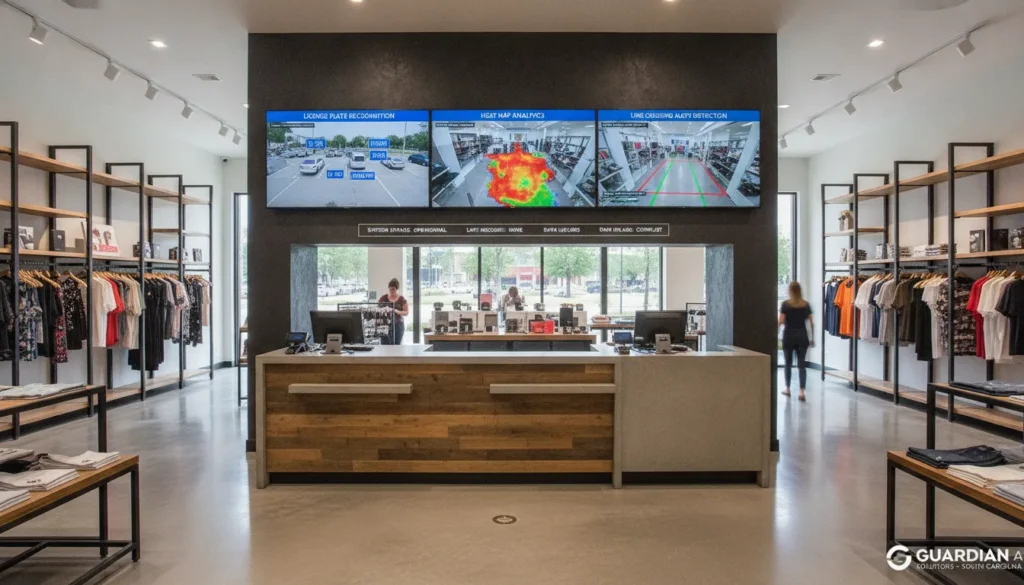
Retail stores in South Carolina lose millions of dollars each year to organized theft and shrinkage. Standard video systems capture the crime on tape but cannot stop it in real time. You need a smarter approach that detects threats before they reach your sales floor. Call (864) 246-1006 today to schedule a free security consultation and learn how AI-powered analytics can protect your Greenville retail store.
Modern retail video analytics South Carolina stores rely on today go far beyond basic recording. These AI-driven tools help business owners spot suspicious behavior, track shopping patterns, and distinguish between a person, a vehicle, or a passing shadow. This capability dramatically reduces false alarms that waste your team’s time. According to Avigilon, artificial intelligence helps security teams focus on verified threats instead of environmental noise. Heat maps, license plate recognition, and line crossing alerts give you a complete operational view of your store. When you connect these analytics with UL-certified monitoring, every alert gets a fast, professional response. Your existing cameras become a source of actionable business intelligence that cuts theft and improves efficiency.
How Does License Plate Recognition Stop Repeat Offenders at SC Retail Stores?
License Plate Recognition (LPR) has become an essential tool for retail security in South Carolina. These systems use specialized cameras positioned at parking lot entrances to capture and log every license plate that enters your property. This creates a searchable record of every vehicle on your premises at all times. Pairing business security cameras with LPR helps you identify threats before they reach your front door.
LPR works by photographing each plate as a vehicle passes through the entry point and converting the image into text data in milliseconds. The system stores the plate number, timestamp, and an accompanying vehicle image. For Greenville retail owners, this eliminates guesswork about who is on your lot. You maintain a searchable database that supports both security operations and business logistics.
How Proactive Alerts Work
The real power of LPR lies in its ability to cross-reference plates against watchlists of known offenders. When a vehicle linked to prior theft or a retail crime ring enters your lot, the system sends an instant alert to your management team. This gives your staff time to prepare or intervene before a theft occurs. Many local businesses use retail video analytics South Carolina solutions to transform passive footage into active defense tools.
Alerts can route directly to a manager’s smartphone or monitoring station. This means your team is on alert the moment a suspect arrives. In many cases, the visible presence of advanced technology alone deters would-be thieves. For Greenville retailers, this is particularly effective against organized groups that target multiple stores in a single day. By sharing plate data across multiple locations, you can track and intercept repeat offenders with minimal effort.
Building Legal Evidence With Vehicle Data
Modern AI-powered LPR systems maintain accuracy in low light and inclement weather. Infrared illuminators read plates at night, and the software handles vehicles at moderate speeds. This precision is critical for building strong cases for local law enforcement. A clear plate number paired with an exact timestamp dramatically accelerates police investigations and helps prosecutors connect suspects to specific incidents.
Long-term data retention also supports pattern analysis. You can review past weeks to determine whether a particular vehicle has been casing your store. This automotive loitering detection represents a new frontier in retail security. For South Carolina businesses, this documented evidence is invaluable for insurance claims and legal proceedings.
Integrated Access Control
LPR integrates seamlessly with access control systems. You can create whitelists of approved vehicles for employees, vendors, and regular delivery drivers. When an authorized vehicle arrives at a gated area, the system automatically reads the plate and grants entry. This eliminates the need for key cards or fobs while keeping unauthorized vehicles out of sensitive zones.
This integrated approach is part of a comprehensive retail security strategy. It reduces the workload on your loss prevention team by automating perimeter monitoring. Instead of watching every camera feed, they can focus on verified threats flagged by the AI. For Upstate South Carolina retailers, these systems offer a sophisticated way to stay ahead of crime while streamlining daily operations.
Line Crossing Detection: Virtual Perimeter Protection for Retail Properties
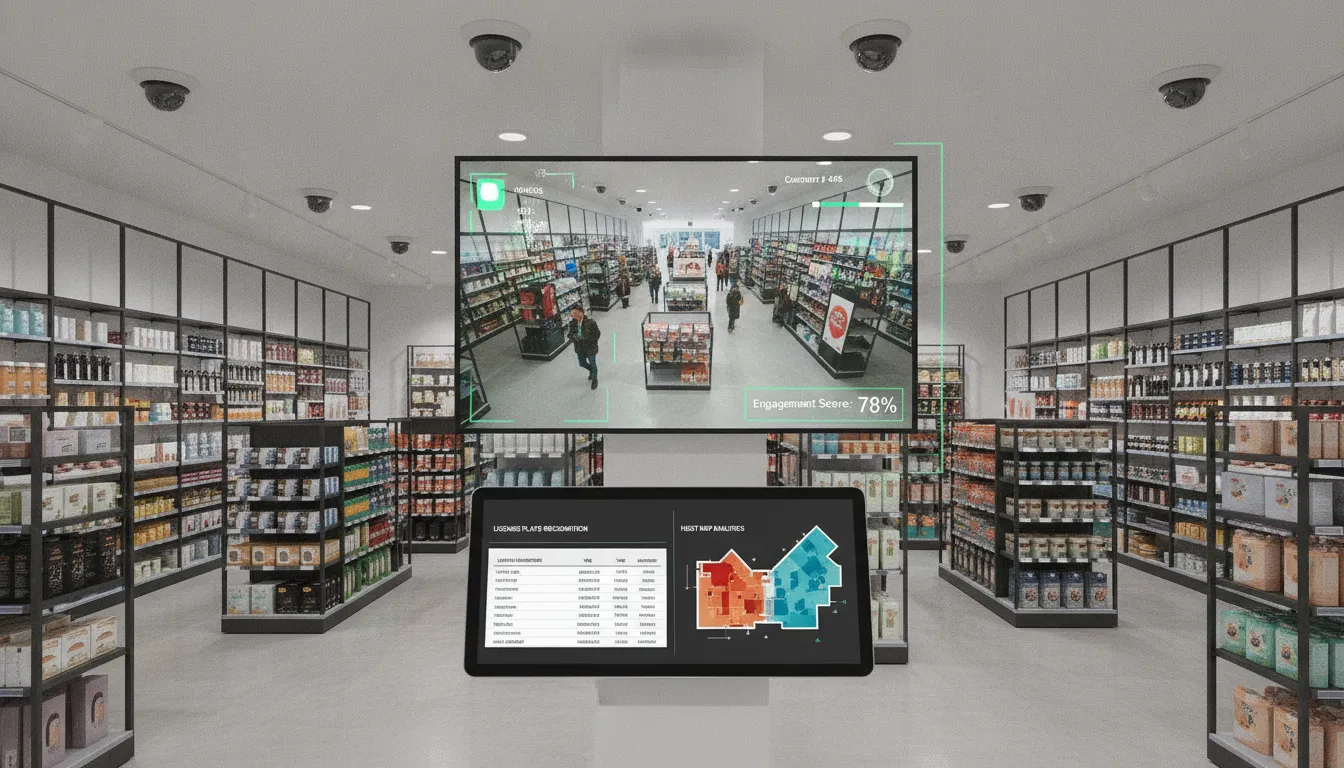
Line crossing detection functions as a digital fence for your retail property. It creates a virtual tripwire that triggers an alert when a person or vehicle crosses a boundary you define on the camera view. Unlike a physical barrier, this invisible line captures intrusions without the intruder knowing they triggered it. These tools help store owners monitor large areas with fewer security personnel and form a core component of retail video analytics South Carolina deployments.
AI-Driven Detection Versus Standard Motion Sensing
Traditional security cameras rely on pixel-change detection, which generates frequent false alarms from moving shadows, lighting shifts, or animals. New AI-powered analytics are far more intelligent. They use object classification to distinguish between people, vehicles, animals, and environmental noise. Research confirms that these systems can identify complex customer behaviors that improve retail security. Because the camera understands what it sees, your team receives fewer irrelevant alerts and can trust the system during peak business hours.
You can configure the system to ignore non-threatening movement such as small animals or wind-blown debris. Alerts fire only when a person or vehicle crosses a defined boundary. Directional settings add another layer: you might want notification when someone enters a stockroom but not when they exit. This granularity makes your commercial security systems more reliable and reduces monitoring fatigue.
Protecting Loading Docks and Restricted Zones
Retail stores contain multiple areas that must remain off-limits to the public. Stockrooms, loading docks, and office spaces are frequent targets for internal and external theft. Line crossing detection provides instant alerts when someone enters these zones without authorization. This outperforms simple door sensors because it covers open areas like bay doors and corridors without requiring additional hardware. Your existing cameras become active perimeter guards.
In South Carolina retail environments, loading docks see constant activity from delivery drivers and staff. You can set a virtual boundary at the dock edge. If a driver moves into a storage area where they do not belong, your security team knows immediately. This stops theft before merchandise leaves the building and maintains a complete audit trail of who accesses each zone.
- Define your zones. Use your video management software to draw virtual lines on each camera view. These lines mark the boundaries of sensitive areas such as stockrooms, cash offices, and emergency exits.
- Set trigger rules. Configure whether alerts fire for one-way or two-way crossing and specify the object types that should trigger the alarm.
- Connect to your alerting system. Link the camera feed to your smartphone or a central monitoring station. When someone crosses a line, you receive a notification with a video clip of the event.
- Respond to the alert. Your team checks the live feed to determine whether the person has legitimate access. If not, they can dispatch security or contact local police.
- Review the data. Analyze crossing logs over time to identify patterns in after-hours access, and adjust your security procedures accordingly.
By implementing these steps, you create a tight security net around your highest-value assets. Line crossing is a cost-effective way to add a protection layer across your entire property, working around the clock to keep inventory and staff safe.
How Can Heat Mapping Improve Your Store Layout and Staffing?
Modern retail video analytics South Carolina systems do more than record security events. Advanced heat mapping tools allow store managers to visualize how customers move through their space. These tools use video data to generate a color-coded map showing where shoppers spend the most time. By analyzing these flow patterns, you can make data-driven decisions about store layout that directly increase revenue.
Understanding Customer Flow and Dwell Time
Heat maps reveal exactly where foot traffic concentrates and where it drops off. They measure “dwell time” — how long a shopper remains in a specific area. If customers gather in an aisle but do not make purchases, you may need to adjust signage, pricing, or product placement. This behavioral data is essential for recognizing customer activity patterns that drive operational improvements.
You can also identify “dead zones” where shoppers rarely venture. Moving high-demand products to these underutilized areas can balance store traffic and increase overall engagement. When you know which displays attract the most attention, you can monetize that prime space through vendor partnerships. This transforms your video system from a security expense into a revenue-generating asset.
Optimizing Staff Schedules With Real Data
Labor is one of the largest operating costs for any retail business. Heat map data shows you exactly when your store experiences peak traffic. Instead of guessing, you can schedule more cashiers and floor staff during high-traffic windows. This reduces checkout wait times and improves the customer experience. Proper intelligent video analytics helps you deploy your workforce where it matters most.
Conversely, during slow periods you can reduce staffing levels to save on labor costs. By matching your schedule to verified foot traffic data, every shopper receives appropriate attention. This balance leads to better service scores and higher conversion rates for your South Carolina retail operation.
Measuring Promotional Impact
When you launch a new display or run a promotion, you need to know whether it is working. Heat mapping shows whether a featured end-cap display actually draws foot traffic. You can compare zone traffic against point-of-sale data to calculate true conversion rates. High traffic with low sales signals an eye-catching display with a weak offer — a clear opportunity for optimization.
This test-and-measure cycle helps you refine your merchandising strategy continuously. You no longer wait for monthly sales reports to gauge promotion effectiveness. Real-time heat maps give you the data you need to make adjustments on the fly. This proactive approach keeps your store ahead of competitors and directly improves your bottom line.
UL-Certified Monitoring: Turning AI Alerts Into Rapid Police Response
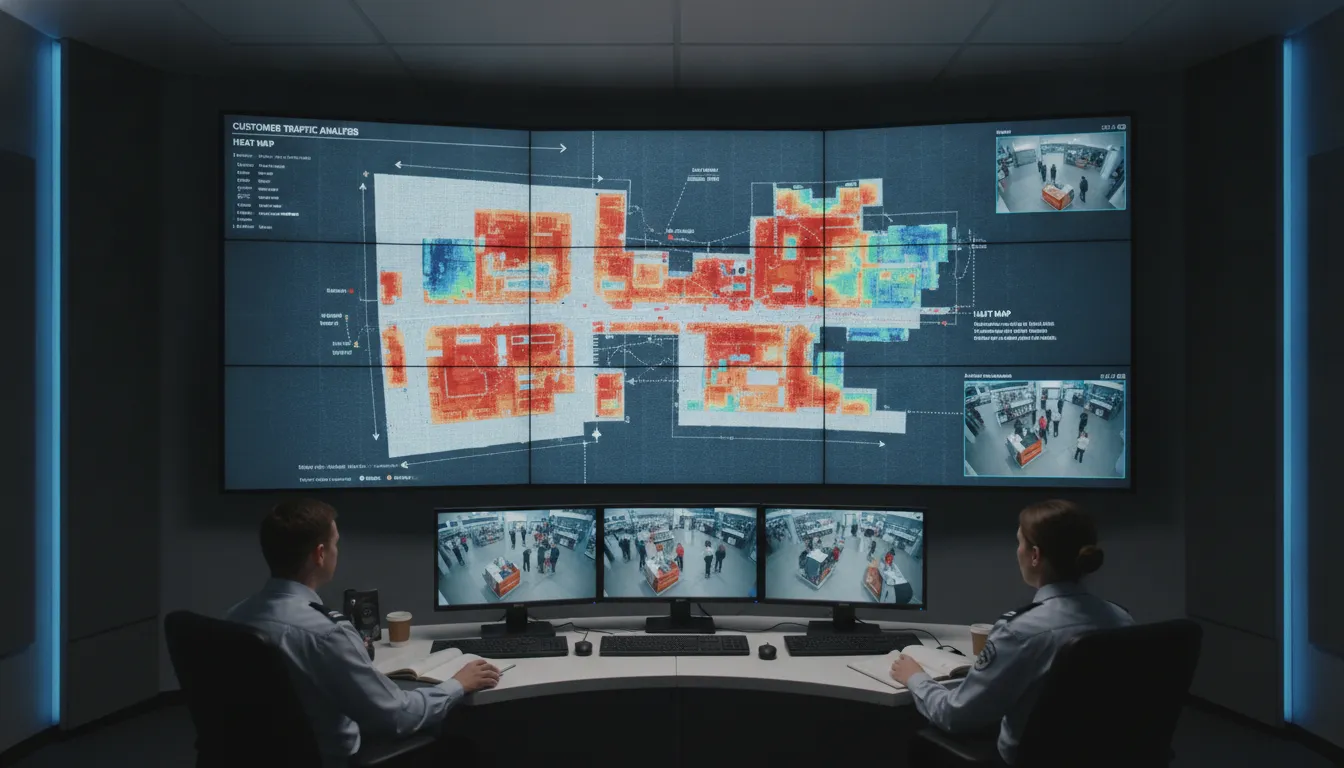
AI analytics make your cameras smarter, but the real value comes from what happens after an alert fires. Most South Carolina retailers rely on mobile phone notifications, which are easy to miss or ignore. By connecting your commercial video surveillance systems to a trained monitoring center, you ensure every verified threat receives an immediate professional response. This turns a video clip into a real security intervention.
What UL 827 Certification Means for Your Store
UL 827 is the highest standard for security monitoring centers. It requires redundant power systems, hardened facilities, and secure data pathways. This infrastructure ensures your store is never left unprotected. When your AI analytics detect a threat, the system forwards a verified video clip to a trained operator who assesses the situation in real time. Only confirmed threats are escalated to local law enforcement, which virtually eliminates false alarm fines.
Modern hierarchical AI systems help monitoring center operators by pre-sorting events. These tools distinguish between a person, a vehicle, and an animal with high accuracy. Operators only see events that require human judgment. This makes the entire response chain faster and more reliable for your retail location. You avoid the stress of checking your phone for every minor motion notification.
Verified Response Versus Self-Monitoring
Self-monitoring often fails when you are asleep, in a meeting, or away from your phone. If a thief enters your store at 3:00 AM, a push notification may not wake you. With professional UL-certified monitoring, a trained operator is always watching. They see the event live, verify the threat, and contact law enforcement immediately. This is the difference between finding a crime scene in the morning and stopping a crime in progress.
| Feature | Self-Monitored Video | UL-Certified With AI |
|---|---|---|
| Alert Source | Phone app notification | Verified AI priority clip |
| Response Time | User dependent | Under 60 seconds |
| False Alarms | High (wind, pests, shadows) | Near zero (AI pre-filter) |
| Police Priority | Low priority (unverified) | High priority (verified) |
| Staff Safety | Owner must investigate | Professional remote guard |
| Infrastructure | Standard office network | UL 827 hardened facility |
Priority Dispatch in South Carolina
In Greenville and across the Upstate, police response times depend heavily on alarm verification. Unverified alarms receive low priority. But when a UL-certified center confirms a crime in progress, dispatchers treat it as a verified emergency. This classification moves the call to the top of the response queue, saving critical minutes when every second counts.
The monitoring operator provides dispatchers with real-time details: suspect descriptions, direction of travel, vehicle information, and any weapons observed. This intelligence helps officers arrive prepared. Businesses that invest in verified commercial security cameras Greenville operators trust experience faster police response and lower overall loss rates.
What SC Compliance Rules Apply to Advanced Video Analytics?
Operating smart cameras in South Carolina requires compliance with state privacy laws. South Carolina is a one-party consent state for audio recording under S.C. Code 17-30-30. This means you may record a conversation if at least one participant consents. In a retail environment, your employees can legally record their interactions with customers. However, you cannot record private conversations between two customers who are unaware of the recording. Most retailers disable camera microphones to eliminate this legal risk and rely exclusively on video data.
Privacy Zones in Public Areas
You may deploy retail video analytics South Carolina cameras in the public areas of your store: sales floors, checkout lanes, entrance vestibules, and parking lots. These spaces carry no reasonable expectation of privacy. However, state law strictly prohibits cameras in areas where patrons expect privacy. Under S.C. Code 16-17-470, placing cameras in fitting rooms, restrooms, or dressing rooms is a criminal offense. Even a camera angle that inadvertently captures the entrance to these areas can create liability.
License Plate Data Retention Rules
License Plate Recognition is a powerful tool for identifying repeat offenders. While South Carolina currently has no specific statute banning LPR use by private businesses, pending legislation (Bill 4675) may establish data retention limits for plate information stored on third-party servers. If you use LPR to track vehicles in your lot, you need a clear data retention policy. Keeping plate data for a limited period helps you stay compliant as regulations evolve and builds trust with customers concerned about data privacy.
Best Practices for SC Retailers
Clear signage is your strongest protection against privacy claims. Post conspicuous notices at every entrance informing customers that the premises uses business security cameras for safety and loss prevention. Maintain a written policy governing how video data is stored, accessed, and retained. Ensure all employees understand the camera system’s capabilities and limitations. A documented training program prevents misuse and creates an audit trail for compliance reviews.
Why Local Expertise Matters
Security regulations evolve rapidly in South Carolina. Working with a local security provider based in Greenville keeps you ahead of legislative changes. Local professionals monitor new court decisions and state bills that affect retail surveillance practices. They can help you configure your system for full compliance while maintaining effective theft deterrence. A thorough on-site assessment identifies optimal camera placements that maximize coverage without encroaching on private areas.
Choosing the Right Video Analytics Partner for Your Greenville Retail Business
Selecting a security technology partner is one of the most important decisions you will make for your retail operation. The right company does more than install commercial video surveillance systems. They help you leverage data to grow your business and protect your team. You need a partner with local market knowledge and access to the latest AI analytics technology.
The Value of Local Expertise
Local knowledge is essential when configuring the commercial security cameras Greenville retailers depend on. A provider based in the Upstate understands the specific crime patterns, weather conditions, and regulatory landscape that affect South Carolina businesses. ADP Security Systems has served Greenville and the surrounding area for more than 30 years. This depth of experience means they understand local retail theft trends and can recommend solutions tailored to your specific risk profile.
Certifications matter. Look for a partner with UL 827 monitoring accreditation, which guarantees their monitoring center meets the highest standards for security, redundancy, and response speed. The combination of experienced local technicians and certified monitoring infrastructure ensures your store receives professional protection at every level.
Questions to Ask Before Signing a Contract
- Do you offer both LPR and heat mapping analytics in a single platform?
- Is your monitoring center UL 827 certified?
- Can your system integrate with my existing camera hardware?
- Do you provide staff training on both the technology and SC privacy compliance?
- What is your average verified response time for law enforcement dispatch?
By asking these questions, you ensure your chosen partner can deliver the full scope of retail video analytics South Carolina retailers need to protect their inventory, optimize their operations, and stay compliant with state regulations.
Frequently Asked Questions
How does retail video analytics differ from standard security cameras?
Standard security cameras record footage for later review. Retail video analytics uses artificial intelligence to analyze video in real time, detecting specific objects, behaviors, and patterns. This allows the system to send instant alerts for events like loitering, unauthorized entry, or vehicle recognition rather than simply storing video for later investigation.
Can existing analog cameras work with AI video analytics?
Yes. Many AI video analytics platforms support hybrid deployments that work with analog cameras through an encoder or network video recorder upgrade. You do not always need to replace your entire camera infrastructure. Software-based analytics can often process feeds from existing equipment, making the upgrade path more affordable. According to the National Science Foundation, new object detection tools simplify how legacy systems identify people and vehicles.
How do heat maps help retail store operations?
Heat maps use camera sensors to track foot traffic patterns across your store floor. They show which aisles draw the most visitors and where customers spend the most time. This visual data helps managers make informed decisions about product placement, staffing levels, and promotional effectiveness. It takes the guesswork out of store layout and helps you serve customers more efficiently.
Is professional monitoring necessary if I already have AI alerts?
AI alerts notify you of potential threats, but professional monitoring ensures those alerts receive a human response. A UL-certified monitoring center evaluates each alert, verifies whether a crime is actually occurring, and contacts law enforcement on your behalf. This eliminates false alarms, provides verified evidence for police dispatch, and ensures your store is protected even when you are asleep or unavailable.
Ready to Schedule a Free Security Consultation for Your Store?
Every day you delay upgrading your security system is another day organized retail criminals can target your South Carolina store. Outdated cameras miss critical alerts, leading to higher shrinkage rates and lower profits. AI-powered video analytics changes this equation by detecting threats in real time and turning your camera system into a proactive defense network.
Our team will assess your current setup, recommend the right mix of LPR, line crossing, and heat mapping analytics, and connect everything to our UL 827 certified monitoring center. Explore our commercial security camera solutions to learn more, or call us today to get started.
Call (864) 246-1006 to schedule your free security consultation.