Access Control System Trends: Keyless Entry and Credentials
July 9, 2026
Choosing a Commercial Fire Alarm Monitoring Service: What SC Building Owners Must Verify
July 13, 2026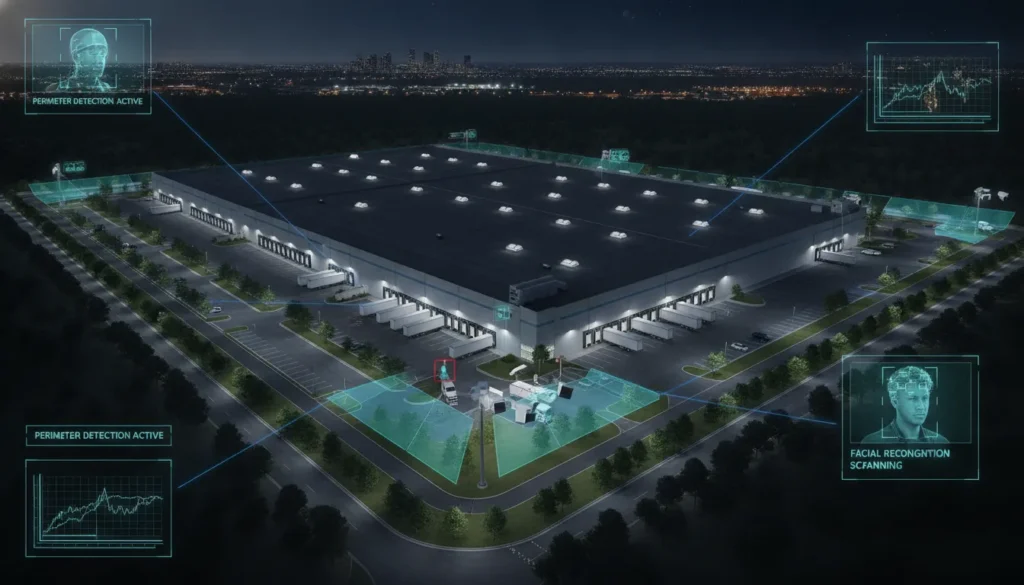
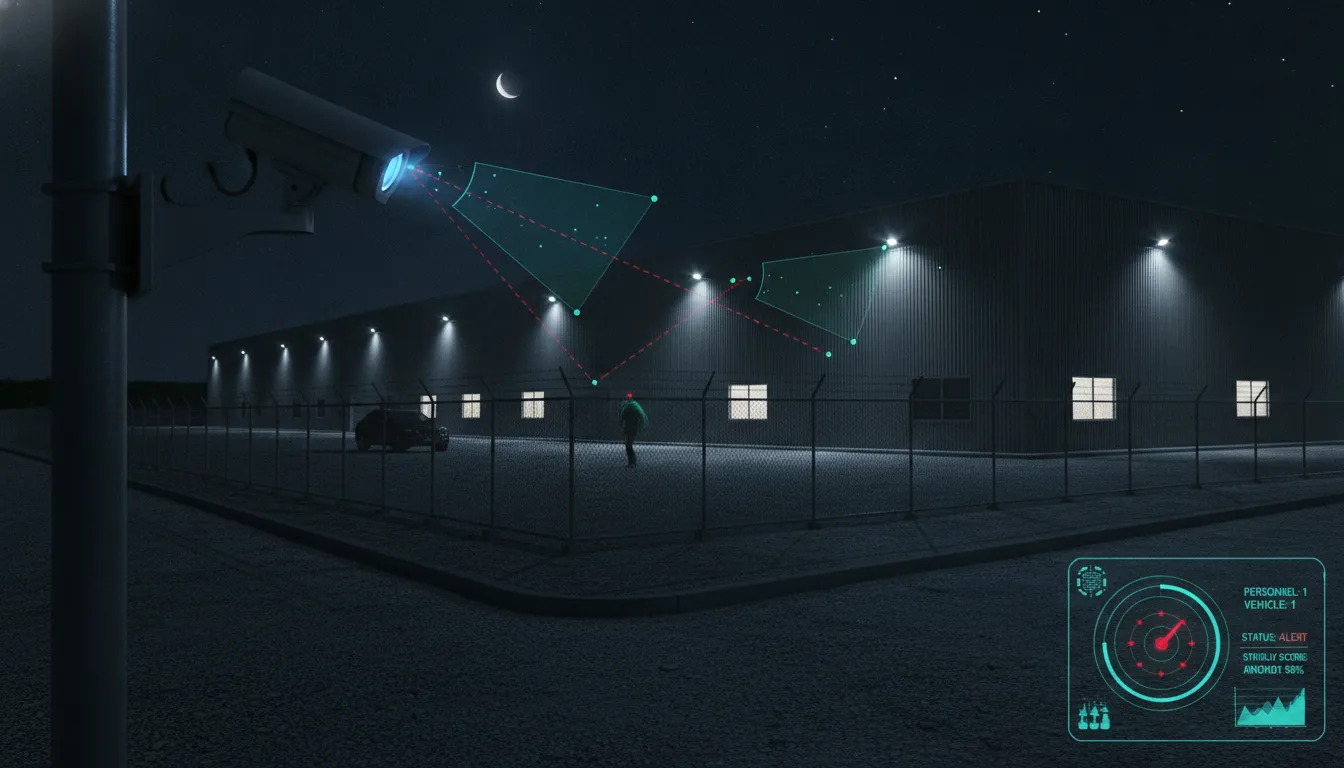
Night-time trespassing at warehouses and industrial facilities costs South Carolina businesses millions of dollars every year in stolen inventory, damaged equipment, and higher insurance premiums. Standard security cameras capture the incident on video, but by the time anyone reviews the footage, the trespassers are long gone and the damage is done. Commercial video analytics changes this equation entirely by using artificial intelligence to detect threats in real time and trigger immediate action. AI-powered security cameras with facial recognition, loitering detection. And automated perimeter alerts give warehouse operators in Greenville and Spartanburg the ability to stop trespassers before they ever reach the loading dock.
Schedule Your Free On-Site Security Assessment Today — ADP Security Systems will evaluate your warehouse and design a custom AI-powered surveillance solution.
How Does AI Video Analytics Detect Night-Time Trespassing?
AI video analytics detects night-time trespassing by using computer vision algorithms trained to recognize human shapes and movement patterns in low-light conditions. The system analyzes live video feeds at the edge, distinguishing between people, animals, and environmental noise to trigger real-time alerts when unauthorized entry occurs.
Traditional closed-circuit television systems passively record whatever happens in their field of view. The footage sits on a hard drive until someone manually reviews it, usually after a theft or vandalism has already occurred. Commercial video analytics flips this model from reactive to proactive by embedding artificial intelligence directly into the surveillance workflow.
AI-powered video analytics uses machine learning algorithms and computer vision technology to analyze live video streams in real time. The system is trained to recognize human shapes, distinguish them from animals, vehicles, or environmental noise, and classify specific behaviors. When a person walks through a warehouse lot at 2 a.m. or approaches a fenced perimeter after hours. The AI identifies the event as a potential trespassing incident and generates an immediate alert.
Modern systems can operate at the edge, meaning the AI processing happens on the camera itself rather than a central server. This edge computing approach delivers sub-second detection latency and continues working even if network connectivity is interrupted. For industrial facilities with large perimeters and multiple entry points, edge-based video analytics ensures continuous protection without bandwidth bottlenecks.
ADP Security Systems integrates AI-powered video analytics into its commercial security camera installations across South Carolina. This gives warehouse operators access to this technology with professional installation and central station monitoring support. For a broader look at how video analytics protects commercial properties, read our guide on AI video analytics for retail security.
Facial Recognition and Loitering Detection for Industrial Sites
Facial recognition and loitering detection are two of the most powerful capabilities in modern commercial video analytics. These features specifically target the patterns that precede trespassing incidents at warehouses and industrial facilities, giving security teams the upper hand against potential intruders.
Facial Recognition for Known Trespassers
Facial recognition systems maintain a watchlist of individuals linked to prior trespassing or theft incidents. When a camera detects a face, the AI cross-references it against the watchlist in milliseconds. If a match is found, the system sends an instant alert to security personnel, facility management, or the central monitoring station. This gives warehouse operators the ability to intercept repeat offenders before they can act.
For South Carolina facilities dealing with organized retail crime or serial trespassers. Facial recognition eliminates the need for security guards to memorize faces or review hours of footage after an incident. The AI does the identification work continuously, around the clock. Modern systems achieve accuracy rates above 95 percent under proper lighting conditions, and the addition of infrared illuminators ensures reliable performance during overnight hours when most trespassing occurs. See how ADP’s best security cameras for business incorporate these advanced AI detection capabilities.
Loitering Detection That Flags Suspicious Behavior
Loitering detection is equally valuable for industrial security. The AI monitors designated zones such as loading docks, equipment yards, and perimeter fences for individuals who remain in the area beyond a configurable time threshold. If someone walks past a warehouse gate and keeps moving, the system ignores them. But if the same person stops, surveys the building, or circles back to examine entry points, the loitering algorithm flags the behavior as suspicious and triggers an alert.
This capability is particularly important for preventing night-time trespassing at South Carolina warehouses. Trespassers often case a facility during the day or early evening, noting camera positions, guard schedules, and access points. Loitering detection identifies this reconnaissance behavior and alerts the security team long before a break-in attempt occurs.
ADP Security Systems configures loitering zones and time thresholds based on each facility’s specific layout and traffic patterns during the initial on-site assessment. Ensuring the system balances security vigilance with minimal false alarms.
Upgrade your security posture with AI-powered loitering detection. Explore ADP’s commercial video surveillance solutions designed for South Carolina industrial facilities.
Automated Perimeter Alerts: Stopping Trespassers Before They Enter
Automated perimeter alerts use AI analytics to create virtual tripwires and intrusion zones that trigger real-time notifications the moment a potential threat crosses them. This proactive approach stops trespassers before they reach the building, giving security teams time to respond.
A warehouse perimeter is the first line of defense against trespassing. Commercial video analytics strengthens this defense by creating virtual tripwires and intrusion zones that trigger automated alerts the moment they are crossed.
Line crossing detection allows security teams to designate invisible boundaries along fences, property lines, and restricted areas. When a person crosses one of these virtual lines, the camera instantly sends a video-verified alert to the monitoring station or facility manager’s smartphone. Unlike traditional motion sensors that trigger on any movement including passing cars or wildlife. AI analytics evaluates the shape, size, and movement pattern of the object before deciding whether to alert. This intelligence reduces nuisance alarms by a significant margin compared to conventional detection methods.
Zone-based intrusion detection takes perimeter protection further by defining specific areas where any human presence after hours triggers an immediate response. Loading docks, equipment storage yards, and fuel stations are common high-risk zones at industrial facilities. When AI detects a person in these areas during off-hours, the system can activate floodlights, trigger audible deterrents, and simultaneously alert the central monitoring station for dispatch coordination.
Video verification is a critical component of this workflow. Rather than sending police to investigate a generic alarm signal, the central station operator views the live video feed from the triggered camera. Confirms the trespassing event, and relays precise details to dispatchers including the number of individuals, their location, and their direction of travel. This reduces police response times and eliminates unnecessary dispatches, saving both public resources and the facility’s false alarm fines.
ADP Security Systems connects automated perimeter alerts directly to its UL 827 certified central monitoring station, providing round-the-clock professional oversight for every triggered event.
How Does Video Analytics Integrate With Central Station Monitoring?
Video analytics integrates with central station monitoring by transmitting video-verified alerts from AI-equipped cameras directly to a UL-certified monitoring center. Where trained operators review the footage in real time, confirm threats, and coordinate emergency dispatch only when a genuine intrusion is verified.
The full power of commercial video analytics is realized when AI detection feeds directly into a professional central station monitoring center. This integration creates an end-to-end security workflow that starts the instant a trespasser enters the property and ends with a coordinated law enforcement response when necessary.
ADP Security Systems operates a UL 827 certified central station that receives video-verified alerts from AI-equipped cameras. When the analytics system detects a potential trespassing event, the following sequence unfolds automatically:
- The AI camera identifies the event and captures a short video clip of the incident
- The clip is transmitted to the central monitoring station alongside the alert
- A trained monitoring operator reviews the video to confirm whether the event is a genuine threat
- If confirmed as trespassing, the operator dispatches the appropriate response which may include contacting the facility manager, notifying local law enforcement, or triggering on-site deterrents
- If determined to be a false alarm such as a stray animal or weather event, the alert is dismissed without dispatching anyone
This video verification process is the key differentiator between AI-powered monitoring and conventional alarm monitoring. Standard alarm systems generate an estimated 94 to 98 percent false alarm rates because they cannot distinguish between a real intrusion and an environmental trigger. Police departments across South Carolina increasingly charge fees for excessive false dispatches, and some jurisdictions have stopped responding to unverified alarm calls altogether. Video-verified alarms eliminate this problem by giving monitoring operators visual confirmation before any dispatches are made.
For warehouse and industrial facilities in the Greenville-Spartanburg area, central station integration means that security continues working even when the facility is unstaffed. The monitoring center provides 24/7 oversight, and facility managers can also view live feeds and alert history from any mobile device through the ADP Security mobile app. Learn how access control systems complement video monitoring for complete site protection.
Commercial Video Analytics vs. Traditional CCTV: Key Differences
The table below compares AI-powered commercial video analytics with traditional CCTV across the features that matter most for warehouse and industrial security in South Carolina.
| Feature | AI-Powered Video Analytics | Traditional CCTV |
|---|---|---|
| Detection method | Active AI analysis in real time | Passive recording for later review |
| Alert generation | Instant alerts for trespassing, loitering, perimeter breaches | No alerts, requires 24/7 human monitoring |
| False alarm rate | Low, AI distinguishes humans from animals and weather | High with motion sensors, none with passive recording |
| Response time | Seconds, immediate video verification and dispatch | Minutes to hours, depends on when footage is reviewed |
| Search capability | AI-powered search for people, vehicles, events across hours of footage | Manual scrubbing through time-stamped recordings |
| Integration | Direct connection to central station and dispatch systems | Requires separate alarm system for monitoring |
| Operational intelligence | People counting, heat maps, traffic patterns, dwell time analytics | None, recording only |
| Night-time performance | Enhanced with IR, thermal analytics, and edge AI | Relies on camera sensor and night vision quality |
| Upfront investment | Higher, includes analytics software and capable hardware | Lower, standard camera and recording equipment |
| Long-term ROI | Reduced theft, lower insurance premiums, fewer false alarm fines | Limited to post-incident evidence gathering |
Setting Up Video Analytics at Your South Carolina Warehouse
Setting up commercial video analytics at a South Carolina warehouse follows a structured six-step process that starts with an on-site security assessment and ends with a professionally monitored AI-powered surveillance system tailored to the facility’s specific layout and threat profile.
Implementing commercial video analytics for trespassing prevention follows a structured process that starts with understanding the facility’s unique security challenges and ends with a fully integrated. Professionally monitored system.
1. Schedule an On-Site Security Assessment
The process begins with a comprehensive walk-through of the warehouse or industrial facility. ADP Security Systems sends a certified technician to evaluate entry points, perimeter fencing, lighting conditions, existing security infrastructure, and high-value asset locations. The assessment also identifies blind spots and areas of previous trespassing activity. This step is essential because every facility has a different layout, and the camera placement strategy must be customized to cover the specific intrusion vectors that matter most. For related reading, check out our guide to commercial IP security systems in South Carolina.
2. Design the Camera and Analytics Layout
Based on the assessment, the security team designs a camera deployment plan that positions AI-equipped cameras at the most critical monitoring points. Perimeter fences receive cameras with line crossing analytics. Entry gates get units with license plate recognition. Loading docks and equipment yards are covered by cameras with loitering detection and intrusion zone analytics. The design also accounts for lighting, sight lines, and cabling infrastructure to ensure optimal AI performance in all conditions.
3. Install AI-Capable Cameras and Network Infrastructure
ADP’s factory-trained technicians install the cameras, run structured cabling to professional standards, and configure the network video recorder or cloud-based storage solution. Modern IP camera networks with NVR architecture support the data throughput required for continuous AI analysis. Cameras are mounted at optimal heights and angles for facial recognition and perimeter detection, with weatherproof housings rated for outdoor installation.
4. Configure Analytics Profiles and Alert Parameters
The analytics system is programmed with the facility’s specific security rules. Loitering time thresholds, intrusion zone boundaries, watchlist entries for facial recognition, and alert routing preferences are all configured during this phase. The system is tested to verify that it correctly identifies threats without generating excessive false alarms. ADP’s team adjusts sensitivity settings based on the facility’s normal activity patterns, ensuring the AI learns what is routine and what warrants an alert. Pair your video analytics with biometric access control for multi-layered site security.
5. Connect to Central Station Monitoring
The analytics system is integrated with ADP Security’s UL 827 certified central monitoring station. Video-verified alerts flow directly to trained operators who provide 24/7 professional oversight. The integration ensures that every detected trespassing event receives a human review and appropriate response, even when the facility is completely unstaffed. Facility managers also gain remote access through the mobile app for real-time camera views and alert management.
6. Train Staff and Establish Response Protocols
Finally, the facility’s management team receives training on the system’s operation including how to respond to alerts. How to use the mobile app, and how to update watchlists or adjust analytics parameters as needs change. ADP provides ongoing support and system testing to keep the analytics performing at peak effectiveness over the long term.
Ready to stop trespassing before it happens? Contact ADP Security Systems for a free on-site consultation and discover how commercial video analytics can protect your South Carolina warehouse around the clock.
Frequently Asked Questions About Commercial Video Analytics
What is commercial video analytics?
Commercial video analytics uses artificial intelligence and machine learning to analyze video footage from security cameras in real time. It identifies objects, people, vehicles, and behaviors such as loitering, trespassing, or perimeter breaches and triggers instant alerts. Unlike traditional CCTV that only records, analytics actively monitors for specific security events.
How does AI video analytics detect night-time trespassing?
AI video analytics detects night-time trespassing using computer vision algorithms trained to recognize human shapes and movement patterns. The system uses infrared or thermal cameras that can see in low light combined with analytics that distinguish between people, animals, and environmental noise. When a person enters a restricted area during off-hours, the system triggers a real-time alert to security personnel or a central monitoring station, often within seconds.
What is loitering detection in video analytics?
Loitering detection identifies when a person remains in a designated area beyond a configurable time threshold. For warehouses and industrial facilities, this helps security teams identify individuals casing the property before a break-in occurs. Alerts can be routed to on-site security, facility managers, or a remote monitoring station for immediate assessment.
Can video analytics integrate with central station monitoring?
Yes. Video analytics systems integrate directly with UL-certified central station monitoring services. When AI detects a trespassing event, the system sends a video-verified alert to the monitoring center. Operators assess the situation in real time using live footage and coordinate with local dispatch only when a genuine threat is confirmed. Reducing response times and eliminating unnecessary dispatches.
What are the benefits of video analytics for warehouses?
For warehouses and industrial facilities, video analytics provides 24/7 perimeter monitoring, real-time trespassing alerts, reduced false alarms. Integration with access control systems, video verification for police dispatch, and operational intelligence such as traffic patterns and loading dock activity. These capabilities dramatically improve security outcomes while reducing the burden on security personnel and cutting costs from false alarm fines.
Ready to Protect Your South Carolina Warehouse with AI-Powered Security?
Night-time trespassing does not have to be a cost of doing business. Commercial video analytics puts real-time threat detection, facial recognition, loitering alerts, and professional central station monitoring to work for your facility around the clock. Call (864) 246-1006 today to schedule a free on-site security consultation with ADP Security Systems. Our certified technicians will assess your Greenville or Spartanburg warehouse, design a custom AI-powered surveillance solution. And connect it to our UL 827 certified monitoring center so your property stays protected every hour of every night. Browse our 2026 commercial security camera buying guide for more on the latest analytics-ready hardware.