Home Security Camera Installation Options
June 19, 2026
Key Card Entry System Guide for Small Businesses
June 22, 2026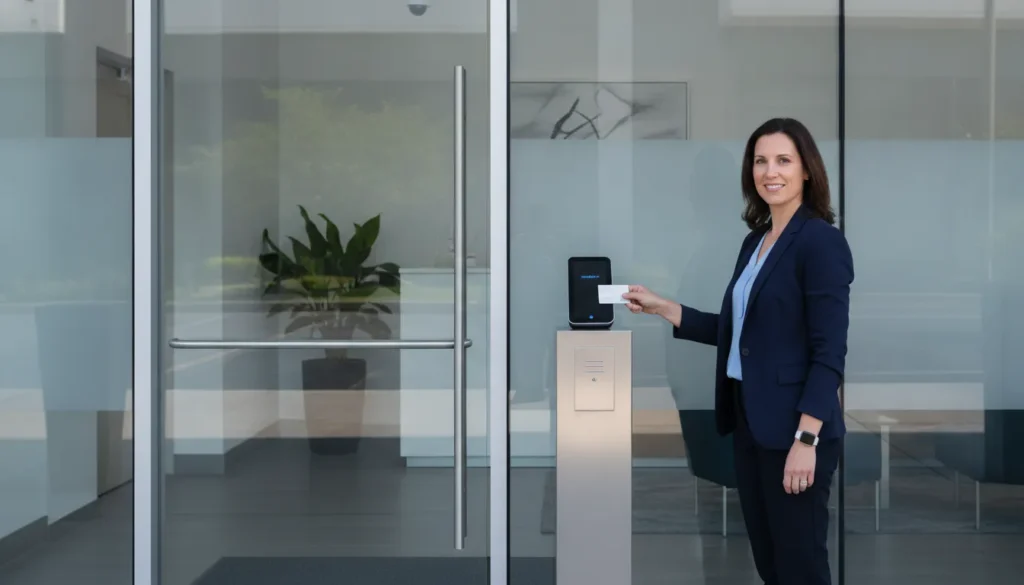
A failed door reader at 7:30 on a Monday morning can stop a shift, delay deliveries, and expose a restricted area. That is why choosing among access control companies is not simply a hardware decision. The right provider must understand how people move through your Greenville-area facility, design the system around real risks, install it correctly, and remain available after the project is complete.
Request a commercial access control assessment from ADP Security Systems.
To compare access control companies, evaluate five areas: site-assessment quality, credential and lock options, integration experience, local service capacity, and total cost over the system’s useful life. Ask each provider to quote the same scope and explain who will design, install, monitor, maintain, and expand the system.
This guide gives facility managers, business owners, and operations leaders a practical framework for comparing proposals. It also explains which questions reveal whether a provider is prepared to support a single Greenville office, a busy Upstate South Carolina facility, or a growing multi-site operation.
What separates reliable access control companies?
Reliable access control companies begin with a detailed site assessment, recommend technology based on operational needs, use qualified installers, and provide documented support after commissioning. They do not treat every doorway or business as interchangeable.
A useful proposal starts with the people and processes the system must support. A provider should ask which doors require control, who needs access, when permissions should apply, how visitors are handled, and what happens during an emergency. It should also account for delivery entrances, employee turnover, restricted rooms, after-hours vendors, and future expansion.
The site assessment is where expertise becomes visible. The provider should inspect door construction, existing locks, power and network availability, life-safety requirements, and the path for new cabling. A recommendation made without seeing the facility may omit hardware, labor, or operational constraints that later become change orders.
Look for accountable design and installation
Ask who owns the design and who performs the installation. Qualified technicians should understand electronic locks, door hardware, credential readers, controllers, network connectivity, and safe egress. The scope should also include testing, administrator training, user enrollment, and a documented handoff.
Professional installation matters because a system is only as dependable as its weakest component. A powerful management platform cannot compensate for a poorly aligned lock, an exposed cable, an unreliable network connection, or permissions that were never tested. ADP Security Systems provides commercial access control systems in Greenville with professional design and installation support.
Evaluate the company behind the equipment
Hardware specifications are easy to compare. Long-term accountability is harder. Find out how long the company has served the region, where its technicians are based, and whether support is handled locally or routed through a distant call center. Ask for a clear escalation path when an urgent issue occurs.
ADP Security Systems is a family-owned, owner-operated company founded in Greenville in 1995. Its more than 30 years of experience provides local context and direct accountability that commercial buyers should weigh alongside the equipment proposal. ADP also provides professional installation, ongoing maintenance, and 24/7 monitoring options for integrated security needs.
How should you compare access control companies?
Compare providers with a written scorecard and a common scope. Score their discovery process, proposed architecture, installer qualifications, integration plan, support response, training, warranties, expansion options, and total ownership cost before comparing the final price.
Start by giving each candidate the same operational brief. List the number and type of doors, approximate user count, locations, desired credentials, reporting needs, existing security systems, and anticipated growth. Without a shared brief, a lower quote may simply cover less work.
- Define the operating problem. Identify the doors, users, schedules, visitor workflows, and risks the system must manage.
- Request an on-site assessment. Require the provider to inspect doors, locks, power, networks, and existing equipment.
- Compare the same scope. Confirm that every proposal includes equivalent hardware, installation, software, training, and support.
- Test the support model. Ask who answers service calls, expected response times, and how emergency requests are escalated.
- Check the expansion path. Determine how the platform handles more doors, users, locations, and integrations.
- Review total ownership cost. Add recurring licenses, monitoring, maintenance, credential replacement, and expected upgrades.
Questions that reveal provider quality
Strong providers welcome detailed questions and answer them in writing. Ask who will be responsible for system administration after launch. Confirm whether your team can add and deactivate users without scheduling a service call. Ask what happens when internet or power service is interrupted and what data remains available.
Also request a demonstration using a workflow that matters to your business. For example, ask the provider to show how a terminated employee’s credential is revoked, how an after-hours door event is investigated, or how a manager reviews access activity across multiple locations. A realistic demonstration is more useful than a tour of every software feature.
Explore commercial door entry system options for your Greenville facility.
Compare credentials, locks, and management platforms
The best technology is not necessarily the platform with the longest feature list. It is the platform that supports your workflows, risk level, environment, and administrative capacity. Compare how each provider handles credentials, door hardware, permissions, reporting, and system availability. For a head-to-head comparison of lock types, see our guide on smart locks vs traditional locks.
| Decision area | What to compare | Why it matters |
|---|---|---|
| Credentials | Cards, fobs, mobile credentials, biometrics, and multi-factor options | Affects convenience, security, issuance, and replacement cost |
| Door hardware | Electronic strikes, magnetic locks, request-to-exit devices, and door position sensors | Must fit each opening and support safe egress |
| Management | Cloud-based or on-site administration, roles, and remote access | Determines how easily authorized staff can manage the system |
| Reporting | Event history, alerts, audit logs, and export options | Supports investigations, compliance, and operational review |
| Resilience | Backup power, offline behavior, data retention, and communications | Determines what happens during an outage |
| Expansion | Additional doors, users, sites, and integrations | Reduces the risk of replacing the platform as the business grows |
Choose credentials around risk and workflow
Cards and fobs are familiar and easy to issue, but they can be shared or lost. Mobile credentials can simplify issuance and reduce physical credential management, although phone policies and user adoption matter. Biometrics and multi-factor authentication may be appropriate for high-risk areas, but they require careful planning and clear administrative controls.
Do not apply the same credential rule to every opening. A general employee entrance, server room, warehouse cage, and executive office may warrant different authentication and logging requirements. A capable provider will explain those tradeoffs instead of recommending the same reader everywhere.
Confirm administrative control
Your team should understand what it can manage independently and which changes require provider support. Ask how administrators create schedules, assign permission groups, deactivate users, review events, and produce reports. Confirm that the provider includes training for more than one administrator and supplies usable documentation.
For offices that rely on cards or fobs, review ADP’s guidance on an office key card system in Greenville before comparing credential-management features.
Look beyond the installation quote
An installation quote is only one part of the financial decision. A complete comparison includes hardware, labor, software, recurring licenses, monitoring, service, training, credentials, warranties, and future expansion. Ask providers to separate one-time and recurring costs so the proposals can be reviewed fairly.
Build a total-cost worksheet
Calculate the expected cost over at least three to five years. Include initial design and installation, recurring platform or monitoring fees, routine maintenance, replacement credentials, expected service visits, and likely additions. If one proposal uses proprietary equipment, ask whether another qualified provider could service or expand it later.
Commercial proposals should also state what is excluded. Common omissions include network improvements, electrical work, permits, door repairs, after-hours labor, lift rental, or integration services. Written exclusions reduce surprises and make it easier to distinguish an incomplete low bid from a genuinely competitive proposal.
Review terms and warranties carefully
Ask how long quoted pricing remains valid, what warranties cover, and whether labor and equipment have different terms. Review cancellation, renewal, ownership, data-access, and service provisions before signing. Contract terms vary by service and provider, so request clear written terms instead of assuming that a residential offer or another company’s policy applies to the commercial project.
Why does local support matter in Upstate South Carolina?
Local support matters because many access control failures involve physical doors, locks, readers, cabling, or power. A Greenville-area provider can combine remote diagnosis with on-site service and can design around local facilities, operating conditions, and business needs.
Remote support can solve permission or software issues, but it cannot repair a damaged reader or realign a door. When access problems interrupt opening, closing, production, or deliveries, the location and availability of qualified technicians directly affect downtime.
Ask candidates where technicians are dispatched from, which counties they routinely serve, and whether they stock common replacement components. Find out how routine and urgent requests are prioritized. A specific response process is more valuable than a vague promise of excellent service.
Use local experience to improve the design
A provider familiar with Greenville, Spartanburg, Anderson, and surrounding Upstate communities can bring relevant experience from offices, warehouses, retail sites, and other regional facilities. That familiarity helps during assessment and installation, especially when older doors, growing sites, or multiple buildings create practical constraints.
Businesses in Anderson evaluating badge entry can review ADP’s business key card entry systems. Multi-location operators should ask how one management platform and one support relationship can cover facilities across the service area.
Plan for cameras, alarms, reporting, and growth
Access control is most useful when it supports a broader security process. Linking door events with video can help a manager review what happened when a credential was used. Connecting access activity with intrusion detection can improve opening and closing procedures. The provider should explain what is possible, what requires additional licensing, and who will maintain each integration.
Ask for specific integration demonstrations
Do not accept the word “integrates” without details. Ask whether the connection is native, supported by both vendors, or custom-built. Request a demonstration of the exact workflow you need, such as viewing video associated with a forced-door alert or reviewing activity after an alarm event.
Confirm how updates to one platform affect the other and who owns troubleshooting when an integration fails. Well-defined responsibility prevents two vendors from blaming each other while the customer waits for a resolution.
Design for the next phase
Discuss likely changes before selecting a platform. If the business may add a warehouse, second office, or more restricted spaces, ask how the system scales. Confirm whether administrators can manage multiple locations from one interface and whether reports can be separated by site, department, or role.
A scalable design does not require buying every future component now. It requires choosing controllers, software, licensing, and network architecture that can support reasonable growth without forcing an early replacement.
Red flags to avoid when choosing a provider
Some warning signs appear before a contract is signed. Treat them seriously because they often predict difficult installation, unexpected costs, or weak long-term support.
- No site visit: The provider gives a firm proposal without inspecting doors, hardware, networks, or workflows.
- Unclear scope: The quote does not distinguish included work, exclusions, recurring fees, and customer responsibilities.
- One-size-fits-all design: Every door receives the same recommendation despite different risks and uses.
- Vague support promises: The provider will not state who handles service, where technicians are based, or how requests are escalated.
- No training plan: The proposal omits administrator training, documentation, and system handoff.
- Unproven integrations: The sales team promises compatibility but cannot demonstrate or document the required workflow.
- Poor expansion path: Adding a door or location requires replacing major parts of the system.
- Pressure without clarity: The provider pushes for a signature before answering technical and contract questions.
Talk with ADP Security Systems about a professionally designed access control solution.
Frequently asked questions about access control companies
How do I choose the right access control company?
Choose a company that performs an on-site assessment, gives you a complete written scope, explains technology tradeoffs, uses qualified installers, and documents ongoing support. Compare total ownership cost and test the provider’s ability to demonstrate the workflows your business needs.
What should an access control proposal include?
A complete proposal should include design assumptions, door-by-door hardware, credentials, controllers, software, labor, network and power requirements, integrations, training, warranties, exclusions, recurring fees, service options, and an expansion path. It should identify customer responsibilities and separate one-time from recurring costs.
Can access control integrate with existing security cameras?
Many modern systems can connect access events with video, but compatibility depends on the selected platforms and integration method. Ask the provider to demonstrate the exact workflow, explain licensing, and document who supports the connection after installation.
Why choose a local provider instead of a national company?
A local provider can offer direct accountability and on-site service for physical problems involving locks, doors, readers, and cabling. National providers may offer broad resources, so compare actual response processes, technician locations, technical capabilities, and contract terms rather than choosing on brand recognition alone.
Request an access control assessment
The best provider comparison begins with a clear view of your facility, workflows, risks, and growth plans. ADP Security Systems has served businesses from its Greenville base since 1995 and provides professional installation, integrated security expertise, ongoing maintenance, and 24/7 monitoring options. Contact ADP Security Systems to request an assessment and a written recommendation for your commercial property.