Commercial Fire Alarm Inspections: SC Compliance Checklist 2026
July 9, 2026
Commercial Video Analytics: How AI-Powered Security Cameras Prevent South Carolina Business Trespassing
July 10, 2026
Metal keys and plastic badges no longer provide adequate security for modern commercial buildings. Lost keys and stolen cards create expensive security gaps that leave property managers exposed. Business owners across Greenville are turning to smarter, software-driven solutions to protect their assets.
Access control system trends in 2025 center on a shift from mechanical locks to cloud-managed digital credentials. Mobile keys let employees unlock doors with their smartphones. Biometric readers add identity verification through fingerprints or facial recognition. Cloud platforms enable managers to grant or revoke access from any device. ADP Security Systems installs and supports these solutions across the southeast with over 30 years of field experience.
Ready to upgrade your building security? Call ADP Security Systems at (864) 246-1006 for a free commercial security assessment in Greenville SC.
What Are the Top Access Control System Trends for 2025 and Beyond?
The commercial access control market is projected to reach $774 million by 2027, growing at 9.4% annually. Key trends include mobile credentials using NFC and Bluetooth, cloud-based remote management replacing on-premise servers, biometric authentication, and IoT integrations that link door access with building automation.
For decades, commercial security relied on metal locks, physical keys, and basic key cards. These methods carry hidden costs. When an employee loses a key, the entire building may need rekeying. Key cards are marginally better, but approximately 20 percent of key cards are lost or stolen annually. Each lost credential represents a potential breach point that property managers cannot easily track.
The shift toward digital access control systems addresses these fundamental weaknesses. Instead of managing physical inventory, security teams control access through software dashboards that log every entry event in real time. According to the National Institute of Standards and Technology, digital credentials provide substantially better protection against fraud and identity theft compared to physical cards. This technological shift lets commercial property owners in Greenville secure multiple buildings from a single interface without managing keys or badges.
How Do Mobile Credentials Work?
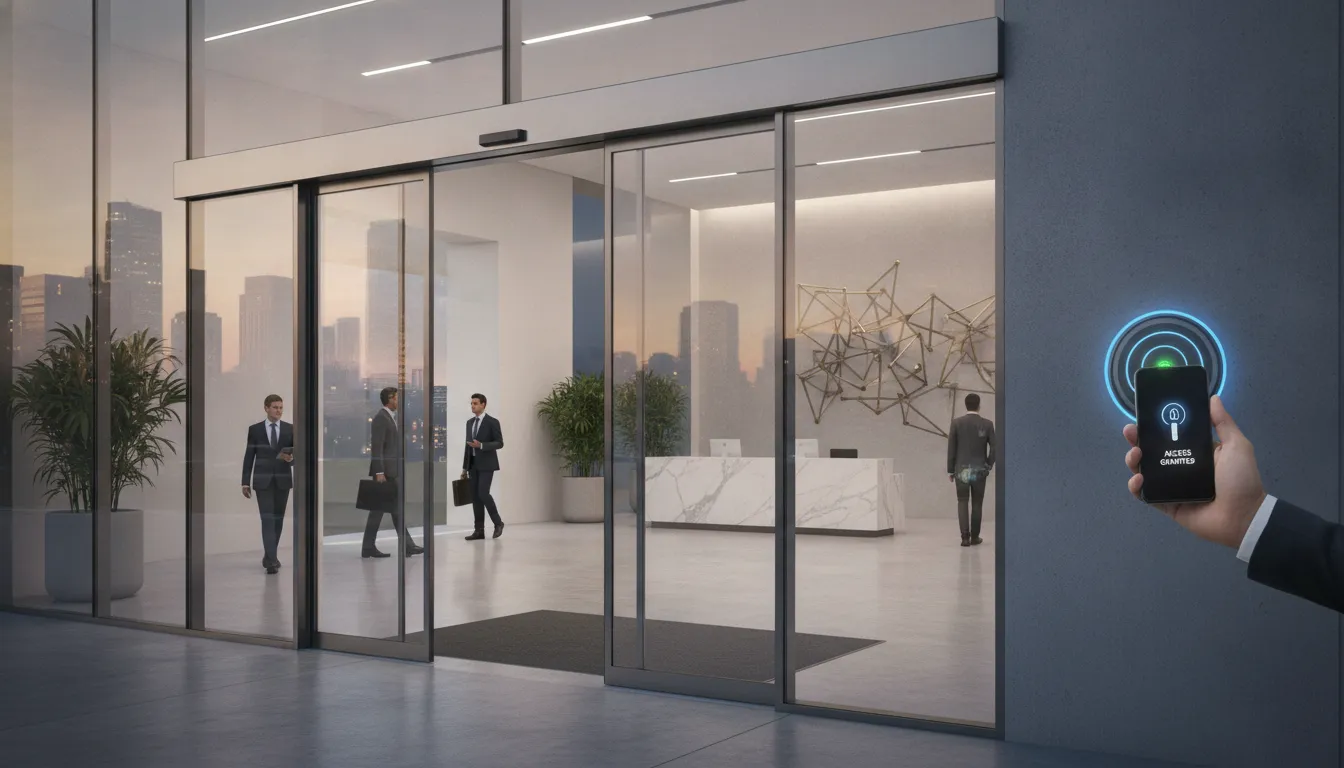
Mobile credentials replace plastic key cards with secure digital tokens stored on a smartphone. The system uses Near Field Communication (NFC) for tap-to-open access or Bluetooth Low Energy for hands-free entry within range. Each credential is encrypted and tied to the phone’s built-in security features, requiring a PIN, face scan, or fingerprint to unlock the door.
The smartphone has become the most practical access credential for modern commercial buildings. Mobile access control systems work through a secure application that communicates with wall-mounted readers. When an employee approaches a secured door, the phone sends an encrypted token using NFC or Bluetooth Low Energy. NFC requires the phone to tap against the reader, similar to a contactless payment. Bluetooth can authenticate from several feet away, enabling hands-free entry for staff carrying packages or pushing carts.
Security advantages over physical cards
Digital credentials solve a persistent security problem. Unlike a lost badge that might go unnoticed for days, a missing phone is typically reported within minutes. The phone itself adds a second authentication factor: the device must be unlocked via PIN, biometric scan, or face recognition before the digital credential can be used. Buildings using mobile credentials report 40 percent fewer tailgating incidents.
Property managers gain significant operational advantages. Onboarding a new employee takes seconds: the administrator sends a digital credential link from the cloud dashboard. When an employee departs, the administrator revokes the credential with one click, eliminating the need to collect physical keys or badges. This eliminates the 20 percent annual card loss rate associated with physical badges.
Cloud-Based Access Control and Remote Management
Cloud-based access control moves security management from on-premise servers to hosted platforms accessible from any web-connected device. A Mercury Security survey found that 52 percent of organizations now use cloud tools for door management. Hybrid models that pair local controllers with cloud dashboards ensure continued operation during internet outages.
Traditional access control systems stored data on local servers inside the building. Checking logs or updating permissions required being on site or connecting through a VPN. Cloud-based platforms eliminate these constraints. Security managers can view real-time access logs, grant temporary visitor credentials, and lock down facilities from a laptop or smartphone, regardless of their physical location.
Hybrid models bridge old and new
Not every commercial property is ready for a complete cloud migration. This has created demand for hybrid systems that pair existing door controllers with cloud-based management interfaces. An industry survey found that 86 percent of security professionals value tools that integrate with legacy equipment. Hybrid models provide fail-safe operation: local controllers continue functioning during internet outages and sync event logs to the cloud when connectivity resumes.
ADP Security Systems uses the Honeywell VISTA platform to bridge this gap for Greenville businesses. The system communicates through both cellular and internet pathways. If one fails, the other automatically takes over. Property managers control the entire system through a smartphone app, giving them peace of mind whether they are on site or traveling. Home automation systems use similar dual-path technology for reliable remote management.
Biometric and Multi-Factor Authentication Options
Biometric access control uses unique physical characteristics such as fingerprints or facial features to verify identity at the door. Fingerprint readers offer a low-cost entry point for small businesses. Facial recognition provides hands-free entry suitable for high-traffic areas and ADA compliance. Multi-factor authentication (MFA) combines two verification methods for high-security zones.
Biometric readers add a layer of security that credentials alone cannot match. Fingerprint scanners are the most widely deployed option, offering reliable authentication at a moderate cost. Facial recognition systems provide instantaneous, hands-free verification and work well in high-traffic lobbies. Modern facial recognition can distinguish between a live person and a photograph, eliminating a common spoofing technique used against older systems.
| Method | Accuracy | Speed | Best For | ADA Friendly |
|---|---|---|---|---|
| Fingerprint Scanner. | High. | Fast. | Offices, retail spaces. | Yes. |
| Facial Recognition. | Very High. | Instant. | High-traffic lobbies. | Excellent. |
| Card + PIN (MFA). | Very High. | Moderate. | Server rooms, labs. | Yes. |
| Phone + Fingerprint (MFA). | Highest. | Moderate. | Compliance zones. | Yes. |
Applying MFA where it matters most
Multi-factor authentication pairs two independent verification methods to create a security barrier that is extremely difficult to bypass. For example, a server room might require both a key card and a PIN code to open. A research laboratory could require a smartphone credential plus a fingerprint scan. These layered approaches ensure that a single lost credential cannot compromise high-value areas.
How Does Access Control Integrate with IoT and Building Automation?
Modern access control systems serve as the hub of a connected building. When a door unlocks, the system can trigger devices to adjust lighting, HVAC, and security cameras. An industry study found that 53 percent of organizations now use occupancy data from access logs to manage building systems and reduce energy costs.
One of the most practical access control system trends is the convergence of physical security with building automation. Door locks no longer operate in isolation. They act as sensors that inform the entire building ecosystem. When an authorized employee enters a secured zone, the system can adjust the room temperature, turn on lighting, and disarm the security alarm for that area. When the last person leaves, the system reverses these actions to conserve energy.
Practical automation benefits for property owners
- Lights and HVAC adjust automatically when zones become occupied or vacant, reducing monthly energy costs.
- Security cameras begin recording when specific doors are opened after business hours, capturing forensic evidence.
- Automatic lockdowns triggered by threat detection prevent unauthorized movement during emergencies.
- Visitor tracking tied to temporary credentials shows exactly who is on site during fire drills or evacuations.
- Mobile credentials integrate with alarm systems to disarm upon entry and rearm upon exit without separate keypads.
- Real-time occupancy data helps facility managers optimize space utilization across multi-tenant buildings.
- Audit logs from access events support compliance reporting for regulated industries including healthcare and finance.
ADP Security Systems integrates door locks with camera systems and alarm monitoring through the Honeywell VISTA platform. If a door is forced open, the camera automatically begins recording, and the monitoring center receives an alert. This interconnected approach stops small security events from becoming major losses. For Greenville businesses managing multiple facilities, unified security management through a single interface provides substantial time and cost savings. The same platform integrates with commercial security camera systems for complete site visibility.
Choosing the Right Access Control Partner for Your Business
Selecting an access control provider requires evaluating technical expertise, local responsiveness, and contract terms. ADP Security Systems has served Greenville and the southeast since 1995 as a family-owned, owner-operated company. All installations are performed by factory-trained employees rather than third-party subcontractors. The company uses a UL 827 certified monitoring center and offers no long-term contracts.
Upgrading to a modern access control system is a significant investment. Choosing the right installation partner determines whether that investment delivers long-term value or becomes a source of frustration. National security companies often rely on third-party subcontractors for installation and service, creating inconsistent quality and delayed response times. Local providers with in-house teams typically offer faster response and higher accountability.
What to look for in an access control provider
Technical expertise matters most. The provider should demonstrate certified training on the specific equipment they recommend, whether that is Honeywell, Bosch, or another brand. Their monitoring center should carry UL certification, which indicates that the facility meets independently verified standards for security and uptime. Ask about contract terms: long-term contracts lock property owners into relationships that may not serve their evolving needs. ADP Security Systems does not require long-term contracts, aligning the provider’s incentive to deliver quality service with the customer’s satisfaction.
For Greenville commercial property owners, the choice between a national brand and a local specialist often comes down to responsiveness. Local providers can dispatch technicians within hours rather than days. They understand the specific security challenges facing businesses in the upstate region. ADP Security Systems provides custom quotes for each project, ensuring that property owners pay only for the components their plan requires. The company also integrates access control with commercial fire alarm systems and security monitoring, creating a single-system solution with one service team and one bill.
Frequently Asked Questions
How do mobile credentials protect against identity theft?
Mobile credentials use encryption protocols aligned with NIST standards to secure digital tokens on the smartphone. Unlike physical cards that can be cloned with inexpensive readers, mobile credentials require the phone to be unlocked and authenticated before the digital key is transmitted. If the phone is lost or stolen, the credential cannot be accessed without the device PIN or biometric verification.
Can existing mechanical locks work with modern access control systems?
Yes, to a degree. Mechanical lock cylinders can be upgraded with electronic trim kits that retrofit existing door hardware with digital control. However, for full benefits including remote management, audit trails, and mobile credential support, property owners typically need to replace mechanical locks with electronic strikes or magnetic locks wired to a control panel. ADP Security Systems offers phased upgrade plans that let businesses transition gradually.
What is the cost difference between traditional and modern access control?
Modern cloud-based access control systems have higher upfront equipment costs compared to basic key card systems but lower long-term operational expenses. Property owners save on rekeying costs, badge printing supplies, and administrative labor for managing physical credentials. Energy savings from IoT integration can offset some of the initial investment over time. Custom quotes reflect the specific number of doors, reader types, and integration requirements.
How long does it take to install a commercial access control system?
Installation timelines depend on the scope of the project. A single-door upgrade with an electronic lock and mobile reader can be completed in one day. Multi-door installations for an entire building typically require one to three weeks depending on door preparation, wiring requirements, and integration complexity with existing alarm and camera systems. ADP Security Systems handles all phases including site survey, hardware installation, programming, and staff training.
Is biometric access control compliant with ADA requirements?
Facial recognition readers are fully ADA compliant because they require no physical contact and no fine motor manipulation. Fingerprint readers can be positioned at accessible heights and typically use touch sensors that respond to light contact. ADP Security Systems evaluates ADA accessibility during site surveys and recommends reader placement and types that meet all applicable standards.
Ready to Secure Your Commercial Property with Modern Access Control?
Upgrading to a modern access control system improves security, simplifies property management, and reduces long-term costs. ADP Security Systems has been helping Greenville businesses transition from mechanical locks to smart, monitored entry control since 1995. Every installation is performed by factory-trained technicians. The company offers custom quotes, no long-term contracts, and Honeywell VISTA integration for unified access, alarm, and camera management.
Call ADP Security Systems at (864) 246-1006 to schedule your free commercial security assessment today.