Cellular Versus Landline Alarms Compared
September 17, 2026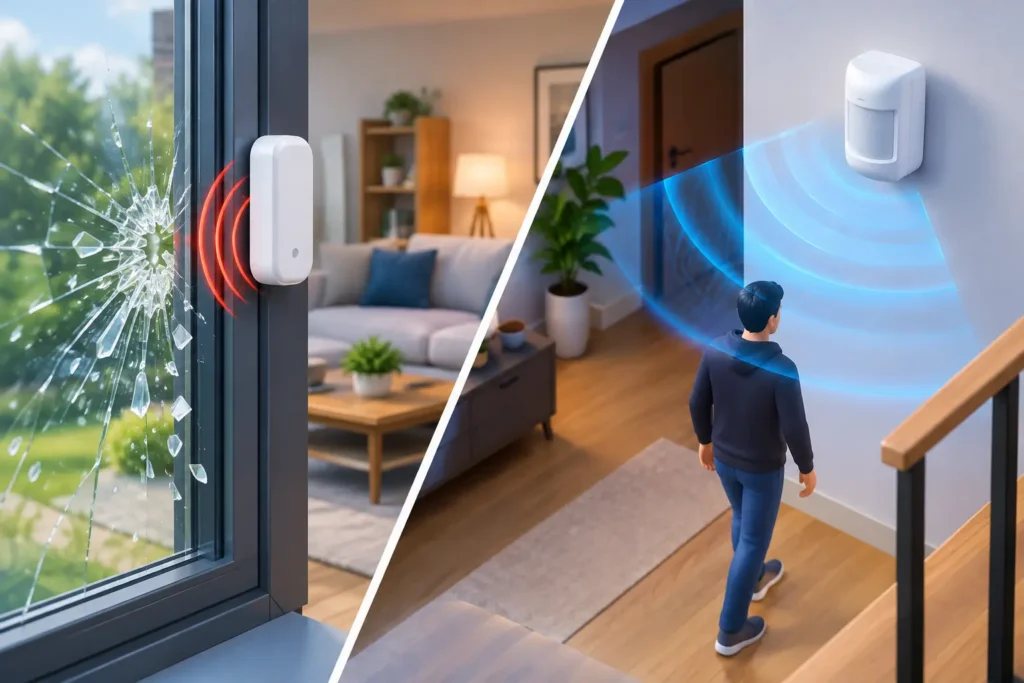
A burglar alarm should detect a break-in in a way that fits how your property is actually used. That is the practical question behind glass break versus motion sensors. Both can play an important role in an intrusion system, but they detect different events, work best in different locations, and have different considerations for pets, room layout, and daily activity.
For many South Carolina homes and businesses, the strongest answer is not choosing one device for every opening or room. It is building layers of protection around the property, then making sure those layers are installed and adjusted correctly.
What Glass Break Sensors Detect
Glass break sensors are designed to recognize the sound pattern created when a window or glass door breaks. Most modern devices listen for the sharp initial impact followed by the frequency associated with shattering glass. When the sensor recognizes that pattern, it sends an alarm signal.
These sensors are particularly useful where an intruder might enter by breaking a window, a sliding glass door, or a glass panel near a door. A single properly placed sensor can often cover multiple windows within its rated area, making it a practical option for rooms with several vulnerable glass openings.
Glass break detection is especially valuable when a window contact alone may not be enough. A contact sensor typically signals when the window is opened. If someone breaks the glass but does not immediately move the window frame, the contact may not activate. A glass break sensor adds another layer by responding to the break itself.
That distinction matters in rooms such as a living room with large windows, a sunroom, or a commercial storefront with glass facing the street. It can also be useful for French doors and glass doors with nearby panels that could be broken to reach the lock.
Where Glass Break Sensors Work Best
A glass break sensor needs a clear acoustic path to the glass it is intended to protect. Open-concept spaces can be good candidates because one sensor may cover several nearby windows. In a business, this may include a showroom, reception area, office with exterior windows, or glass-front retail space.
Placement matters. Heavy curtains, closed interior doors, unusual room shapes, and long distances can affect how sound reaches the device. Every model also has its own coverage specifications. A professional installer evaluates the room rather than assuming one sensor can protect every piece of glass on a floor.
Glass break sensors are not a replacement for window contacts, cameras, or good locks. They are an added detection method for a specific forced-entry risk.
What Motion Sensors Detect
Motion sensors typically detect movement within a protected area after the security system is armed. Many residential systems use passive infrared technology, often called PIR, which detects changes in heat patterns as a person moves through the sensor’s field of view. Commercial systems may also use dual-technology devices that combine detection methods for added verification in challenging environments.
Unlike a glass break sensor, a motion sensor does not need to be near a window or door. It watches the path an intruder is likely to take after entering. This makes motion detection an effective interior layer for hallways, living areas, stairways, stockrooms, offices, and other spaces that lead deeper into the property.
Motion sensors can provide broad coverage with relatively few devices when placed well. A sensor positioned to view a main hallway, for example, may catch movement from several bedrooms or entry points. In a business, one well-selected sensor can help protect a corridor connecting offices, storage areas, and points of access.
Where Motion Sensors Work Best
Motion detection is often most effective when it covers interior travel routes rather than attempting to watch every corner. The goal is to create a dependable alarm path if someone gets past an exterior door, window contact, or glass break sensor.
A motion sensor may be a strong choice for a home with limited glass but multiple entry doors. It can also protect an area where someone could enter through an opening that is difficult to secure with a traditional contact, such as an attached garage or a large open room with several access points.
For commercial properties, motion sensors are commonly used in interior offices, warehouses, equipment rooms, and areas where valuable inventory is stored. They are also useful after hours, when normal employee movement has stopped and any unexpected activity deserves attention.
Glass Break Versus Motion Sensors: The Key Difference
The simplest way to compare glass break versus motion sensors is to look at the event each one is meant to detect. Glass break sensors respond to a likely method of entry: breaking glass. Motion sensors respond to a likely next step: someone moving through the protected space.
Glass break detection can alert earlier in the entry sequence, at the moment glass is broken. Motion detection may activate only after someone has crossed into the room or hallway. That does not make motion less valuable. It makes it a different layer of protection.
There are trade-offs. A glass break sensor is focused on glass and will not help with an intruder who enters through an unlocked solid door. A motion sensor covers movement but is usually not the right choice for an occupied area while the system is armed in away mode. Each device is most effective when used for the risk it was designed to address.
Pets, Daily Routines, and False Alarm Concerns
Homeowners often ask whether a dog or cat will trigger a motion sensor. Many modern motion devices offer pet-immunity features and can be selected based on the size and behavior of household pets. Still, pet immunity is not a promise that every situation is problem-free. A large dog jumping onto furniture, multiple pets moving together, or a pet passing very close to the sensor can affect performance.
The answer may be to use carefully placed pet-aware motion sensors, rely more heavily on perimeter devices while the family is home, or adjust the armed settings around the household routine. A professional assessment helps identify the best approach without leaving key areas unprotected.
Glass break sensors also need thoughtful placement and testing. They are designed to distinguish breaking glass from common household sounds, but installation quality matters. A sensor should be placed according to manufacturer guidance and tested as part of system setup and ongoing service.
Businesses have their own considerations. Loading activity, warehouse equipment, overhead doors, HVAC airflow, and changing inventory layouts can all affect sensor selection and placement. In these environments, the right device is not simply the least expensive one. It is the one that can perform reliably in the actual conditions of the space.
When You May Need Both
Many properties benefit from using window and door contacts, glass break sensors, and motion sensors together. Contacts help identify an opening. Glass break sensors add detection for shattered glass. Motion sensors provide interior backup if an intruder gets through the perimeter.
Consider a home with a rear sliding glass door, kitchen windows, and a hallway leading to bedrooms. A contact on the sliding door, glass break coverage for the glass openings, and a motion sensor watching the hallway create several opportunities for the system to detect suspicious activity.
A retail business may use contacts on exterior doors, glass break detection near the storefront, and motion sensors covering the sales floor and stockroom. For a facility manager, that layered design can also be paired with security cameras and access control to provide a clearer picture of activity and a more controlled environment.
There is no need to add devices just for the sake of having more equipment. The right design focuses on real entry points, valuable areas, building layout, and how people use the property every day.
Professional Placement Makes the Difference
Security equipment is only as useful as its placement, programming, and support. An improperly aimed motion sensor can miss a key path or create unnecessary activations. A poorly located glass break sensor may not provide the coverage a homeowner or business owner expects.
ADP Security Systems takes a consultative approach to these decisions, looking at the building, routines, entry risks, and protection goals before recommending equipment. Professional installation also helps ensure sensors work with the broader alarm system, smartphone controls, video options, and 24/7 monitoring service.
The best next step is to walk through your property with an experienced security professional and ask a simple question: if someone tried to enter here, how would the system know? The answer should give you confidence that your home, business, and the people who depend on it are protected from more than one angle.