Do Cameras Work at Night? What You Need to Know
September 15, 2026
Glass Break Versus Motion Sensors for Your Home
September 19, 2026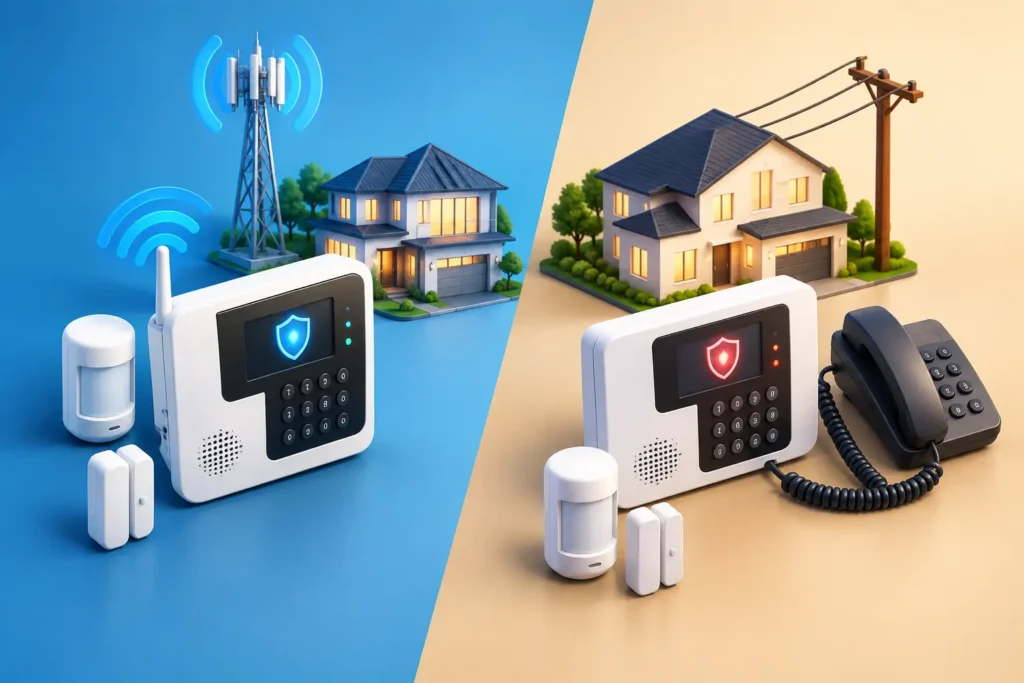
A phone line can look like a dependable choice until an intruder cuts it outside the building, a storm damages local infrastructure, or a provider changes the way voice service reaches your property. When comparing cellular versus landline alarms, the real question is not which technology is newer. It is which communication path can reliably tell a monitoring center that help may be needed when your property is under stress.
For most South Carolina homes and businesses, cellular alarm communication is now the stronger long-term option. Still, a landline can have a place in certain applications, especially when paired with a second communication path. The right answer depends on the property, its existing equipment, local cellular coverage, and the level of protection you need.
How Alarm Communication Works
Your alarm panel is responsible for detecting an event: a door opening, motion in a protected area, smoke, a panic signal, or another programmed condition. The communicator is the part of the system that sends that event to the central monitoring station.
With a traditional landline system, the panel uses a dedicated telephone line to place a signal through the phone network. With a cellular system, the panel sends encrypted alarm signals over a wireless cellular network. In either case, trained monitoring operators receive the event, follow the response plan for the account, and contact emergency services or designated contacts when appropriate.
The communicator matters because an alarm system cannot provide the same level of monitored protection if it cannot report an event. A loud siren may alert neighbors, but it does not replace a verified signal reaching a 24/7 monitoring center.
Cellular Versus Landline Alarms: Key Differences
The most meaningful differences come down to vulnerability, reliability during common disruptions, cost, and long-term support.
Vulnerability to physical tampering
A traditional phone line can often be located and cut outside a home or business. That does not mean every landline alarm is easy to defeat, but the wiring creates a physical point an intruder may target before attempting entry.
A cellular communicator does not rely on an exposed phone wire at the property. It communicates wirelessly, making it much harder to disable by cutting a cable. This is one reason cellular monitoring has become the preferred option for many professionally installed intrusion, fire, and life-safety systems.
Dependence on phone service
Many property owners no longer maintain a conventional telephone line. They may use mobile phones only, or their “landline” may actually be a voice-over-internet service supplied through a modem or cable gateway.
This distinction is critical. A true traditional copper phone line may continue operating during some local power outages because it receives power from the telephone network. Internet-based phone service usually depends on power at the modem, router, and provider equipment. If the power fails and backup batteries are depleted or absent, the alarm may lose its reporting path.
Cellular systems avoid dependence on the property’s internet and phone service. They do, however, require an adequate cellular signal and an active service plan. A professional site assessment helps confirm that the selected communicator has reliable coverage where it will be installed.
Performance during power outages
Neither type of communication path eliminates the need for backup power. The alarm panel itself needs a working backup battery so it can continue to detect and report alarms when utility power is unavailable.
Cellular networks are designed with backup capabilities at many locations, but severe weather, prolonged outages, and high call volume can affect service. Traditional telephone lines can also fail when poles, cables, or switching equipment are damaged. There is no single communication method that is immune to every event.
For properties where uninterrupted reporting is especially important, such as commercial facilities, monitored fire systems, and high-value locations, a dual-path setup may be the better choice. This approach uses two independent paths, commonly cellular plus internet or cellular plus a phone line, so one can support reporting if the other is unavailable.
Speed and supervision
Modern cellular communicators can provide frequent supervision signals that confirm the panel is still connected. If the monitoring center stops receiving those signals, it can identify a communication problem sooner than a system that checks in less often.
The exact reporting and supervision schedule depends on the equipment and service plan. What matters is that the system is programmed, tested, and maintained correctly. A communicator is only as dependable as the installation behind it, including the panel battery, antenna placement, wiring, and monitoring configuration.
Long-term technology support
Landline infrastructure is becoming less common, and older alarm communicators may not work reliably through newer digital phone services. Cellular technology also changes over time. Older 2G and 3G communicators, for example, have been retired as carriers make room for newer networks.
That does not make cellular a short-term solution. It means the communicator should be selected with future support in mind and reviewed when carriers announce network changes. A security provider should be able to identify aging equipment before it becomes a monitoring interruption.
When a Landline Alarm May Still Make Sense
A landline communicator may still be reasonable when a property has a stable, true traditional phone line, cellular coverage is weak inside the building, and the system is not relied on as the only critical reporting path. Some existing systems can also remain in service temporarily while an owner plans an upgrade.
For a location with challenging cellular reception, an installer may be able to improve performance through proper antenna placement or select a communicator that works with a stronger available carrier. In other cases, using two paths is more prudent than choosing one method and hoping conditions remain unchanged.
The key is not to assume that a phone jack automatically equals dependable alarm communication. The type of telephone service, the condition of the wiring, and the system’s ability to report during an outage all deserve attention.
Why Cellular Is Often the Better Choice for Homes
Homeowners generally choose cellular alarm monitoring because it supports protection without requiring a household phone line. It also works well with systems that offer smartphone access, remote arming, video alerts, environmental monitoring, and home automation features.
If a family is away when a storm causes a power interruption, a properly maintained system can continue operating on battery backup and send signals through its cellular communicator. If someone attempts to disable the home’s phone or internet line, that action does not automatically stop cellular alarm reporting.
Cellular communication is also practical for vacation homes, newly built homes, and households that use mobile phones as their primary contact method. It removes one more piece of aging infrastructure from the protection plan.
What Businesses and Facility Managers Should Consider
Commercial decisions require a broader review. A retail store may need burglary monitoring after hours. An office may require access control, video surveillance, and monitored intrusion detection. A warehouse, healthcare facility, or multi-tenant property may have more demanding life-safety and fire alarm requirements.
Start by identifying what must continue reporting during a disruption. Then consider building construction, cellular signal strength, the availability and reliability of internet service, backup power, and any code or insurer requirements. For critical applications, redundancy is often worth the additional investment because the cost of a missed signal can be far greater than the cost of a second communication path.
Businesses should also plan for service continuity. If the alarm relies on a phone line that is being disconnected, converted to internet voice service, or moved during a renovation, the monitoring provider should be involved before the change takes place. A small telecommunications change can create a large security gap if it is not tested afterward.
Professional Installation Makes the Difference
Selecting cellular service is not simply a matter of replacing a phone cord with a wireless device. A qualified technician should test the location, confirm panel compatibility, install the communicator correctly, verify signal strength, program the account information, and perform a full communication test with the monitoring center.
Ongoing maintenance matters as well. Backup batteries age. Carrier networks evolve. Construction changes can affect wireless signal conditions. Scheduled inspections and prompt service help keep the communication path ready when it is needed.
For more than 30 years, ADP Security Systems has helped South Carolina property owners build protection around their actual risks rather than selling a one-size-fits-all package. That includes evaluating whether cellular, landline, internet, or dual-path communication best supports the system at hand.
A dependable alarm is not defined by the wire or signal alone. It is defined by a complete plan: properly installed equipment, reliable monitoring, tested backup power, and a communication path that can still speak up when the unexpected happens.