Business Security Assessment Checklist for Safer Sites
August 4, 2026
Vacation Home Security System South Carolina Guide
August 5, 2026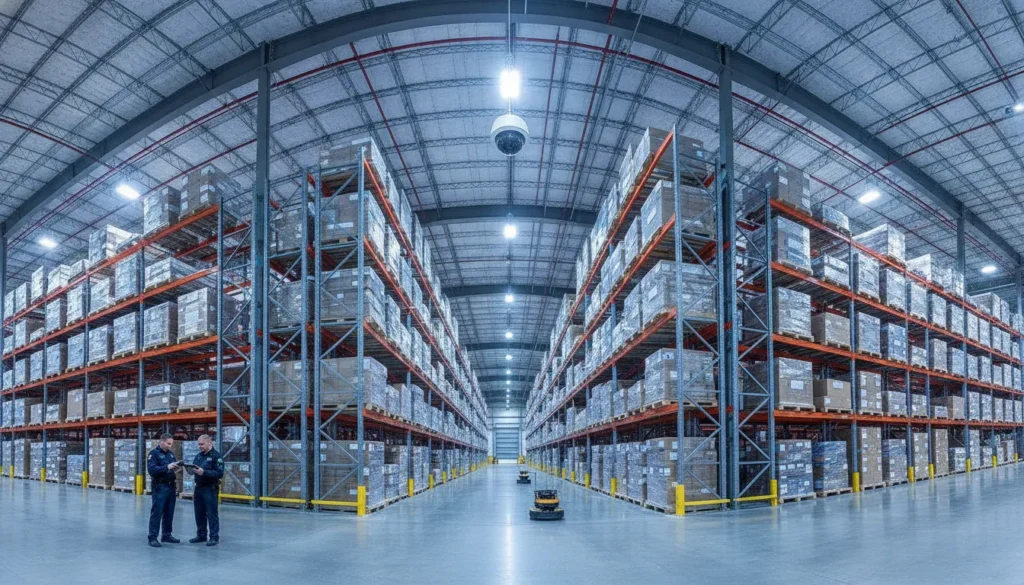
A warehouse can look secure from the loading dock while leaving gaps between employee entrances, inventory aisles, shipping areas, and after-hours access. In South Carolina, logistics facilities must protect valuable cargo, support worker safety, and keep operations moving without creating unnecessary delays.
Effective warehouse security systems South Carolina facilities rely on combining intrusion detection, high-resolution video surveillance, and access control, supported by professional monitoring and a plan built around the property. This layered approach helps managers identify activity, control who enters sensitive areas, review events, and respond sooner when something is wrong.
The risk is broader than a forced door. The CDC and NIOSH documented a fatality rate of 7.7 per 100,000 workers in warehousing and storage, while the FBI notes that cargo theft can connect to organized criminal schemes. Facility layout, traffic patterns, staffing, and the value of stored goods all shape the right protection strategy, as the next section explains.
Why Warehouses and Distribution Centers in South Carolina Face Unique Security Risks
South Carolina’s logistics network supports major manufacturers, suppliers, and distribution operations, with the Greenville-Spartanburg corridor playing a central role. BMW’s Spartanburg plant and Michelin’s regional presence illustrate the scale of activity moving through the state. For warehouse operators, that scale creates more than a general commercial security concern. It creates a combination of high-value inventory, constant vehicle movement, multiple access points, and a workforce that may operate across several shifts.
Large facilities create more opportunities for unauthorized access
A warehouse rarely has just one security boundary. Loading docks, employee entrances, emergency exits, parking areas, receiving bays, and trailer yards each create a potential point of entry. Large floor plans can also leave blind spots between aisles, storage racks, and staging areas. A basic alarm at the main office may not identify who entered, where they went, or whether a door was propped open after hours.
Commercial properties are a substantial part of the burglary problem. The U.S. Chamber of Commerce reports that approximately 30% of burglaries involve non-residential buildings. That figure reinforces why warehouse security should account for the entire property, not just the administrative entrance. A practical business security assessment can help identify exposed doors, weak perimeter areas, lighting gaps, and vulnerable delivery points before they become incidents.
Logistics operations face both crime and safety exposure
Warehouses must protect inventory while keeping people and equipment moving safely. CDC/NIOSH research reported a fatality rate of 7.7 per 100,000 workers in warehousing and storage during the study period, underscoring the hazards associated with material handling and transportation work. Security cameras, controlled access, and documented event records can support incident review, help clarify what happened, and give managers better visibility across a busy facility. These systems should complement, not replace, established safety procedures and training.
Cargo theft adds another layer of risk. The FBI notes that cargo theft offenses can be part of larger criminal schemes, including organized crime rings and drug trafficking. That makes trailer yards, scheduled pickups, receiving procedures, and shipment documentation important security considerations. Warehouse security systems South Carolina businesses deploy should connect perimeter detection, video verification, and access controls so unusual activity can be assessed quickly.
Because every facility has a different layout, inventory profile, and operating schedule, the right design begins with a site-specific risk review. The goal is not simply to install more devices. It is to place the right combination of detection, verification, and controlled entry where the operation is most exposed.
Essential Components of a Warehouse Security System
A warehouse security system works best when each layer supports the others. Access control helps determine who can enter, video surveillance shows what happened, and intrusion detection identifies activity that should not be occurring. This multi-layered approach, combining access control, video, and intrusion detection, is a recognized foundation for commercial security systems (source).
| Layer | Primary function | Best application in a warehouse |
|---|---|---|
| Intrusion detection | Detects unauthorized entry | Perimeter doors, loading bays, restricted storage zones, after-hours monitoring |
| Video surveillance | Records and verifies activity | Docks, aisles, parking areas, high-value inventory locations, entry points |
| Access control | Manages who enters and when | Employee entrances, offices, server rooms, contractor zones, receiving areas |
Intrusion detection for early warning
Intrusion detection protects more than exterior doors. A properly designed system can monitor loading bays, interior zones, restricted storage areas, and other points where an unauthorized person could move through the facility. Honeywell VISTA control panels can support systems with up to 48 zones. Giving a security professional room to separate and identify activity across a warehouse rather than treating the building as one undifferentiated space.
Communication reliability matters just as much as detection. Dual-path communication using cellular and internet connections provides redundancy if one connection is interrupted. When an alarm signal needs to reach a monitoring center, this added path can help maintain communication during an internet outage or other service disruption.
Video surveillance for visibility and accountability
Security cameras give managers a way to review entrances, shipping and receiving areas, parking lots, aisles, and high-value inventory locations. They can support investigations, help clarify incidents, and provide remote visibility when a manager is away from the facility. Camera placement should follow the warehouse workflow, with attention to blind spots, changing light, camera height, and the need to identify people or vehicles.
For facilities comparing options, this advanced camera systems guide can help explain the role of resolution, recording, and system design in a commercial environment.
Access control for people and entry points
Access control establishes practical boundaries around employee entrances, offices, inventory rooms, server areas, and other restricted spaces. Credentials can be assigned according to job role, shifts, or contractor access, while entry records help managers understand who accessed a location and when. The system should also account for visitors, terminated credentials, deliveries, and temporary access needs.
Together, these layers support proactive loss prevention. Security systems and proactive surveillance are critical tools for reducing inventory shrinkage in warehouse environments, while also giving staff a clearer process for responding to suspicious activity. ADP Security Systems can assess the facility layout, operations, and risk points before recommending an integrated design with professional installation and 24/7 UL 827 certified monitoring.
Video Surveillance for Large Logistics Facilities
Large warehouses need more than a few cameras pointed at the main entrance. A useful surveillance plan follows the movement of people, vehicles, inventory, and packages across the entire property, from perimeter gates to loading docks and interior aisles. For facilities in Greenville, Spartanburg, and throughout South Carolina, the goal is clear coverage that supports loss prevention, employee safety, and timely response.
Build coverage around the warehouse layout
High-resolution 4K/8MP IP cameras can capture the detail needed to review faces, license plates, shipping labels, and activity around dock doors. Placement should account for lighting, aisle height, blind spots, parking areas, trailer staging, and entrances used by employees, vendors, and drivers. License plate recognition can add another layer at vehicle entrances, helping teams identify traffic patterns and investigate activity around the property.
An IP-based network video recorder, or NVR, provides a central architecture for recording and reviewing footage. Storage requirements depend on camera count, resolution, frame rate, retention period, and whether cameras record continuously or only when activity occurs. A professional design should balance useful retention with network capacity, secure access, and the facility’s operational needs. For a broader look at storage and camera planning, see this commercial security camera guide.
Use analytics to prioritize attention
AI-powered video analytics can help distinguish ordinary warehouse movement from events that deserve review. Configured correctly, analytics may identify an intruder entering a restricted zone, unusual activity near a loading dock, movement after hours, or a person crossing a defined perimeter. These tools do not replace trained monitoring or a documented response plan. They help reduce the burden of watching every camera feed at once, allowing staff to focus on alerts with greater potential significance.
Cloud-based management can give authorized managers 24/7 mobile monitoring from virtually any location. While remote viewing from a phone, tablet, or computer supports faster decisions when no one is at the facility. Managers can review live video, investigate recorded events, and coordinate with on-site personnel without returning to a security office. Explore AI-powered warehouse security for more on analytics and trespass detection.
Video surveillance works best as part of an integrated warehouse security system, connected with access control and intrusion detection. That combination can show who entered, what happened, and where the event occurred, giving a South Carolina logistics facility a clearer operational picture.
Access Control Solutions for Warehouses and Distribution Centers
Large South Carolina distribution centers need more than a locked exterior door. Managers may need to control movement through loading docks, inventory storage areas, maintenance spaces. And administrative zones, while keeping an accurate record of who entered each area and when. A properly designed access control platform gives each role the right level of access without slowing down normal warehouse operations.
Match credentials to each role
Mobile credentials let authorized employees use a smartphone instead of a physical badge, which can simplify onboarding, credential changes, and access removal when staffing changes. The system can assign different permissions to drivers, warehouse associates, supervisors, contractors, and office staff. For example, a shipping employee may need access to a loading dock during a scheduled shift, while an inventory manager may also need access to secured storage areas.
Visitor management adds another layer of accountability. Visitors and contractors can be checked in, issued time-limited credentials, and restricted to approved areas. These controls help warehouse leaders distinguish routine employee access from temporary access when reviewing an incident or investigating a missing shipment. Businesses comparing access control providers should ask how each platform handles multiple zones, schedules, visitor records, and rapid credential revocation.
Choose the deployment model that fits the facility
Cloud-based access control can make it easier to manage multiple buildings, update permissions remotely, and review activity from a central dashboard. An on-premise system may appeal to organizations that want local infrastructure and direct control over system hosting. The right choice depends on the number of sites, internal IT resources, connectivity, compliance requirements, and long-term expansion plans. This guide to cloud-based access control explains the practical differences between both approaches.
For industrial locations, dual-path communication using cellular and internet connections can provide monitoring redundancy if one communication route fails. That resilience matters when access events, alarms, or system health alerts need to reach the monitoring team without interruption.
Connect access events with time and attendance
Integration with time and attendance systems can reduce duplicate data entry and improve visibility into staffing patterns. Authorized badge or mobile credential events can help confirm when employees begin and end a shift, identify access outside scheduled hours, and support accurate labor records. Access data should complement, not replace, a dedicated timekeeping process, with permissions and retention settings configured to match company policy.
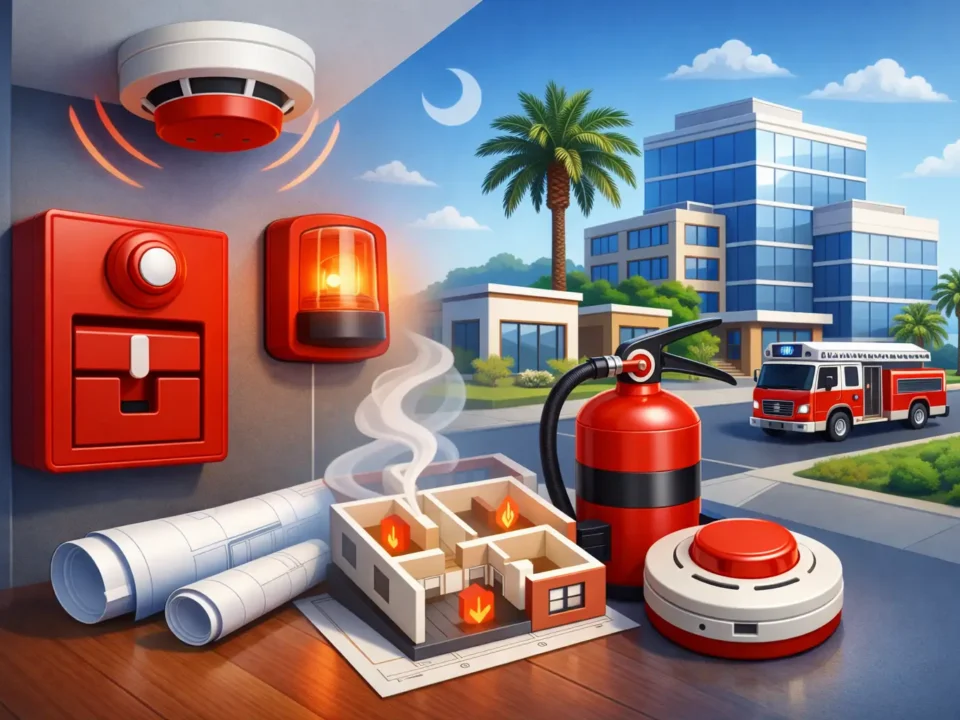
Commercial Fire Alarm Systems for Industrial Properties
Fire protection is a critical part of a warehouse security plan, not an optional add-on. Industrial properties often combine large floor areas, high storage racks, loading activity, electrical equipment, and changing inventory conditions. A properly designed alarm system helps detect a developing fire early, alert people on site, and support an organized response while protecting employees, facilities, and valuable stock.
Designing for warehouse conditions
Commercial fire alarm design should reflect the building’s layout, ceiling height, storage configuration, occupancy, environmental conditions, and emergency procedures. Detection and notification devices need to be placed so alarms can be heard or seen throughout the property. Including offices, production areas, storage zones, mechanical spaces, and loading docks. Integration with other security components can also help a facility coordinate fire response with access control, monitoring, and emergency communications.
NFPA 72 compliance and system selection
NFPA 72 provides the National Fire Alarm and Signaling Code framework used for the design, installation, inspection, testing, and maintenance of fire alarm systems. The right architecture depends on the facility’s size and operational needs. Conventional systems divide a property into zones, while addressable systems can identify the specific device or location reporting an event. That added detail can help responders investigate an alarm more efficiently in a large or complex industrial building.
Because code requirements can vary by property type and jurisdiction, facility owners should work with qualified professionals. The local authority having jurisdiction, and their insurer when planning or modifying a system. Fire alarm protection may also be legally required based on occupancy, construction, or stored materials.
Testing, inspection, and ongoing maintenance
Fire alarm systems require more than a successful installation. Testing and inspection schedules may be annual or more frequent, including bi-annual service where applicable under the adopted codes, system design, or site requirements. Maintenance should document device performance, notification appliances, batteries, supervisory signals, monitoring communications, and corrective work. ADP Security Systems provides full commercial fire alarm systems design, installation, testing, and maintenance, helping South Carolina businesses keep protection dependable as their facilities change.
How to Choose the Right Warehouse Security Systems in South Carolina
The best system starts with the facility, not a product list. Before comparing cameras, alarms, or access readers, map how people, vehicles, inventory, and visitors move through the property. A system designed for a compact storage building may leave blind spots in a large distribution center, while an oversized installation can add cost without improving protection.
Match coverage to the facility layout
Start with the building footprint, ceiling height, racking configuration, dock doors, offices, employee entrances, parking areas, and perimeter. Divide the site into coverage zones, then define the event each zone must help you detect or investigate. Typical zones include:
- Perimeter and vehicle areas: Monitor gates, fencing, trailer parking, and approaches to the building.
- Loading docks: Capture faces, pallets, trailer interiors, and handoffs at usable angles.
- Inventory aisles: Choose camera placement and lighting that preserve visibility between tall racks.
- Access points: Track employee, contractor, and visitor entry with access control and video verification.
- Critical rooms: Protect server rooms, high-value storage, alarm panels, and shipping records.
Do not assume one device type will cover every zone. For expansive open areas, audio sensors may monitor up to 5,000 square feet. According to the supplied Sonitrol warehouse reference, offering a useful comparison point when evaluating detection coverage. Pair that capability with appropriately placed video, intrusion detection, and access control rather than treating it as a replacement for those layers.
Evaluate the integrator, not just the equipment
Ask whether the provider has experience with warehouses, distribution centers, industrial traffic, and South Carolina operating conditions. Confirm the team’s monitoring and installation credentials, including UL-related certifications where applicable, knowledge of NFPA requirements, documented maintenance practices, and response procedures. A qualified integrator should explain why each device belongs in a specific zone, how alerts are prioritized, and how evidence will be retrieved after an incident.
Use this security assessment checklist to organize questions before vendor meetings. It can help expose gaps that a basic equipment quote may overlook.
Plan for expansion and verify the design on site
Growing operations may add racks, dock doors, buildings, shifts, or remote locations. Confirm that the platform can support additional cameras, users, credentials, storage, and monitoring without forcing a complete replacement. Ask about cybersecurity, software updates, integrations, and ongoing service.
A site survey should be the final decision point before installation. The integrator should inspect lighting, network paths, power, camera sightlines, signal strength, and environmental conditions, then provide a zone-by-zone proposal. For a deeper look at camera specifications and storage decisions, review this commercial security camera guide.
Ready to compare warehouse security systems South Carolina facilities can rely on? Schedule a consultation with ADP Security Systems to review your layout, coverage priorities, and growth plans before selecting equipment.
Frequently Asked Questions
Do warehouses have security?
Yes. Effective warehouse security typically combines physical safeguards, monitored intrusion detection, video surveillance, access control, and fire protection. The right design depends on the facility’s size, layout, operating hours, inventory, loading areas, employee access points, and South Carolina location. A professional assessment can identify blind spots and prioritize improvements without disrupting daily operations.
What are the four types of security systems used in warehouses?
The four main categories are video surveillance, intrusion detection, access control, and fire alarm systems. Cameras help document activity and support real-time response. Intrusion detection identifies unauthorized entry, access control manages who can enter specific areas, and fire alarms provide life-safety protection. These systems work best when coordinated through a layered security plan.
What are the top three security systems for a distribution center?
For most distribution centers, the core combination is commercial video surveillance, access control, and intrusion detection. Together, they help security teams see activity, control movement through doors and restricted zones, and receive alerts when unexpected activity occurs. Larger facilities may also need fire alarm integration, visitor management, monitored communications, and specialized protection for docks, yards, offices, and high-value inventory areas.
Which CCTV camera is best for a warehouse?
There is no single best camera for every warehouse. Wide-angle cameras can cover open storage areas, while fixed or varifocal cameras may be better for loading docks, entrances, aisles, and perimeter views. Resolution, low-light performance, mounting height, weather resistance, storage architecture, and analytics also matter. A site survey should match each camera to its viewing distance, lighting conditions, and security objective.
Ready to Strengthen Your Warehouse Security?
A well-planned security system can help your South Carolina warehouse protect valuable inventory, manage facility access, and give your team clearer visibility across the property. To discuss your facility, priorities, and next steps, contact ADP Security Systems online to schedule a free consultation.