Commercial Fire Alarm System Guide for SC Businesses
August 13, 2026
How to Choose Commercial Security Cameras for Business
August 14, 2026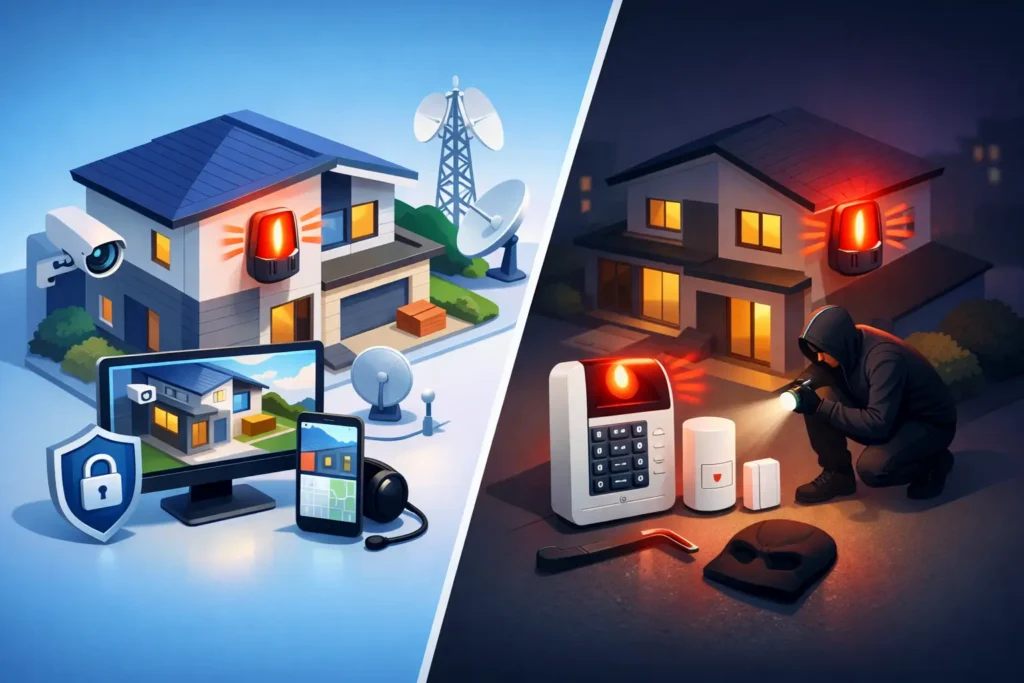
A siren can alert people nearby, but it cannot call for help when a property is empty, a family is asleep, or a business owner is out of town. That is the practical difference at the center of monitored versus unmonitored alarms. Both can detect an intrusion, fire condition, or other event. The question is what happens after the system detects it.
For South Carolina homeowners and business owners, the right answer depends on the property, the risks involved, and who is realistically available to respond. An alarm should fit daily life, not create another responsibility that someone has to manage at all hours.
How monitored versus unmonitored alarms work
An unmonitored alarm is a local system. When a sensor detects a problem, the system may sound an interior or exterior siren, flash a light, send a notification to a smartphone, or record video. The owner, a neighbor, or someone on site must see the alert and decide what to do next.
A monitored alarm sends alarm signals to a professional central station as well. Trained operators review the signal, follow the account’s response instructions, contact designated people when appropriate, and request emergency dispatch when the event warrants it. This provides a trained point of contact even when the property owner cannot answer a phone or access an app.
Monitoring does not mean every alarm automatically brings police or fire responders to the door. Response procedures can vary by alarm type, local policy, permit requirements, verification process, and the information available. What monitoring does provide is a live, documented response process instead of relying solely on an individual to notice a notification and act.
What an unmonitored alarm can do well
Unmonitored systems can be a reasonable choice for lower-risk settings where someone is almost always present. A small workshop occupied every day, a detached garage near the home, or a residence where the owner wants basic local deterrence may benefit from a siren, cameras, and mobile alerts.
The biggest advantage is usually cost. There is generally no monthly professional monitoring fee, and some systems can be installed with a limited number of devices. Smartphone alerts also give hands-on owners visibility when a door opens, motion is detected, or a camera identifies activity.
Still, an app notification is not the same as emergency response. A homeowner may be driving, working in a meeting, traveling, asleep, or without cell service. A business owner may receive an alert at 2:00 a.m. but be unable to safely investigate. If a break-in is underway, asking a family member or employee to confront it is rarely the right plan.
Unmonitored alarms also place more responsibility on the owner to maintain batteries, test communication, update contacts, review settings, and respond consistently. The equipment may work exactly as designed, yet the protection plan can fail if no one receives or acts on the alert.
Why professional monitoring changes the response
A monitored system adds people and procedures to the technology. When an alarm signal reaches the central station, operators have the account details and response instructions needed to take the next step. That can be especially valuable during events that develop quickly, such as a fire alarm, medical emergency, panic signal, or after-hours intrusion.
For a family, monitoring means there is another layer of protection when parents are at work, children are home from school, or everyone is away for the weekend. For an older adult using a medical alert device, it can mean one-touch access to trained assistance after a fall or health event, including situations where reaching a phone is difficult.
For businesses, professional monitoring supports continuity. Retail stores, offices, warehouses, houses of worship, medical offices, and other facilities often sit empty for long periods. A monitored burglar or fire alarm provides a defined response path when a keyholder is unavailable. It also reduces the temptation to send staff to investigate a potentially dangerous situation.
A professionally installed system can be designed with dependable communication methods, properly placed sensors, backup power considerations, and clear user training. ADP Security Systems pairs that local installation and service approach with 24/7 monitoring by Five Diamond-certified central-station operators, giving customers a knowledgeable resource beyond the equipment on the wall.
Costs: Look beyond the monthly fee
The ongoing fee for monitoring is the most visible difference, but it should not be the only cost considered. An unmonitored system may appear less expensive at the start, particularly if it is self-installed. Over time, however, owners may need to replace batteries, troubleshoot connectivity, upgrade devices, or pay for separate camera storage and cellular service.
A monitored system typically includes a recurring service cost because trained operators and communications infrastructure are available around the clock. It may also require professional installation and, depending on the system, a service agreement. Those costs should be discussed clearly before installation.
The better comparison is the cost of the protection gap. Consider the financial and personal impact of a fire that goes unnoticed, a burglary discovered hours later, a vulnerable loved one unable to reach help, or a false sense of security created by notifications no one sees. Monitoring is not necessary for every property, but its value rises when a delayed response could have serious consequences.
Reliability depends on system design and upkeep
Whether an alarm is monitored or not, reliability begins with proper design. A single motion detector in the wrong location will not protect a property as effectively as a system built around actual entry points, activity patterns, and risks. Cameras can help verify activity, but they do not replace door contacts, glass-break detection, smoke detection, or access control where those devices are needed.
For monitored systems, reliable communication is also essential. Many modern systems use cellular communication rather than relying only on a traditional phone line. Backup batteries help keep the alarm operating during a power outage. Regular testing and scheduled maintenance help identify weak batteries, damaged sensors, communication issues, and changes to the property that affect coverage.
Business owners should also separate intrusion protection from fire protection. Commercial fire alarm systems may be governed by codes, inspections, local authorities, and insurance requirements. A required fire system should be evaluated by qualified professionals rather than treated like a basic do-it-yourself security device.
Who should choose each option?
Unmonitored alarms can make sense for owners who want local deterrence and are prepared to manage alerts themselves. They are often best suited to lower-risk properties, situations with dependable on-site supervision, or users who view the system as an added notification tool rather than their primary emergency response plan.
Monitored alarms are often the stronger fit for primary homes, vacation homes, families with children, people who travel regularly, businesses that close overnight, facilities with valuable assets, and anyone responsible for an elderly or medically vulnerable loved one. They are also a practical choice for customers who want support rather than another app they must watch constantly.
A hybrid approach is common. A monitored intrusion and life-safety system can be paired with video surveillance, smartphone controls, smart locks, temperature alerts, and automation features. The owner gets visibility and convenience, while the central station provides response when an alarm signal requires more than a notification.
Questions to ask before choosing an alarm
Start with the moments when no one is available. Who responds if an alarm occurs while you are on vacation, at work, in the hospital, or asleep? Who has access to the property, and would you feel comfortable asking them to investigate an alarm after dark?
Then consider what you are protecting. A basic local alarm may be enough for a low-value outbuilding. A home with children, a business with inventory, or a property requiring fire protection warrants a more detailed assessment. Ask how the system communicates, what happens during a power outage, whether maintenance is available, and exactly how alarm signals are handled.
The right system is not simply the loudest siren or the least expensive monthly plan. It is the one that gives your household, staff, or loved one a clear path to help when they need it most.