How to Prevent Tailgating Access at Work
November 14, 2026
Remote Monitoring for Upgraded Business Security
November 15, 2026
Last Updated: November 12, 2026
Quick Summary
A fire alarm mesh network lets every device act as both a sensor and a relay, forwarding alarm signals through multiple neighboring nodes until they reach the control panel. This multi-hop routing creates redundant paths, so a single failed node does not necessarily cut off the rest of the network, and it avoids running conduit through finished walls in retrofits.
- Each mesh node transmits to the strongest available neighbor, which forwards the message toward the panel.
- Each hop adds only milliseconds of latency, keeping total alarm transmission time short.
- A proper RF site survey should confirm each node has at least two viable communication paths.
- Skipping the RF survey is the most common cause of weak coverage and nuisance trouble signals.
- Nodes that relay more messages may drain batteries faster than edge devices.
Table of Contents
- How a Radio Frequency Fire Alarm Mesh Network Routes Signals
- The Core Advantages of a Fire Alarm Mesh Network Over Wired Systems
- What Wireless Fire Alarm Systems Mean for Retrofits and Older Buildings
- Fire Alarm Radio Mesh Coverage in Difficult-to-Reach Areas
- Fire Alarm Mesh Network Reliability: Latency, Supervision and Failure Modes
- Code Compliance, RF Planning and Cybersecurity Before You Install
- Wireless Fire Alarm System Costs and Lifecycle Budgeting
- Get a Free Fire Alarm Assessment for Your Property
- Frequently Asked Questions
How a Radio Frequency Fire Alarm Mesh Network Routes Signals
A radio frequency fire alarm mesh network is a fire detection system in which each device, called a node, communicates wirelessly with multiple neighboring nodes and relays alarm signals across the network until they reach the control panel. This architecture determines how fast and how reliably an alarm reaches the monitoring center.
The routing logic is straightforward. Each device transmits to the strongest available neighbor, and that neighbor forwards the message toward the panel. No single cable or single radio link carries the whole building.
Mesh Nodes, Subscriber Units and Multi-Hop Communication
Every device on the network acts as both a sensor and a relay. A smoke detector that senses smoke does two jobs: it reports the alarm, and it passes along signals from devices farther away.
This is multi-hop communication. A detector in a basement closet may not reach the control panel directly, but it can reach a device one floor up, which forwards the signal onward. Each hop adds only milliseconds of latency, so the total alarm transmission time stays short even across several hops.
The fire alarm control panel remains the brain of the system. It supervises every node, logs events, and hands the alarm to the central station over the monitoring communication path.
The Core Advantages of a Fire Alarm Mesh Network Over Wired Systems
Resilience is one advantage often cited for mesh networks: because devices can relay signals along alternate routes, a single failed node does not necessarily cut off the rest of the network. Readers weighing mesh networks against other options can review alternatives to wireless fire alarm systems before committing.
Here is how the two approaches compare:
| Feature | Wired System | Radio Mesh System |
|---|---|---|
| Installation | Conduit, cable pulls, wall penetrations | Mount devices, commission network |
| Retrofit fit | Disruptive in finished buildings | Minimal disruption |
| Failure response | Circuit fault can drop a zone | Self-healing reroute |
| Coverage planning | Cable route design | RF site survey required |
| Best for | New construction, high-rise | Retrofits, hard-to-wire areas |
Redundant Paths, Self-Healing and Fault Tolerance
Redundant paths are one way a mesh network can keep forwarding signals when a single device goes offline.
What Wireless Fire Alarm Systems Mean for Retrofits and Older Buildings
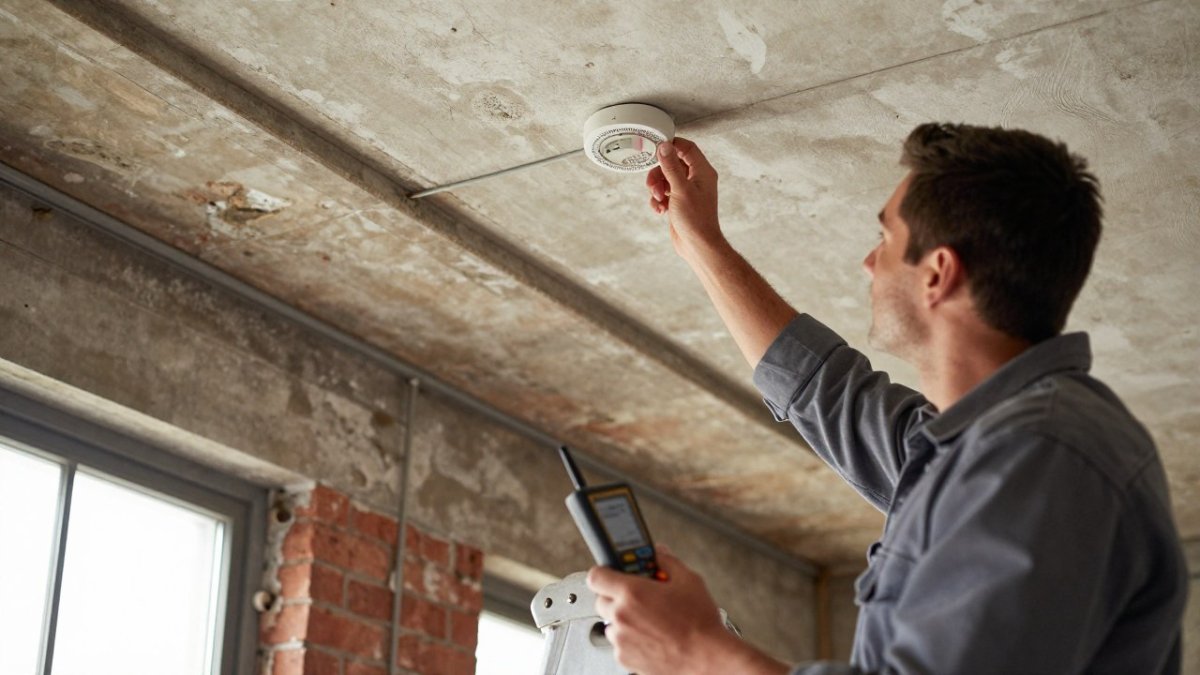
For older buildings, wireless fire alarm systems can avoid some of the work of running conduit through finished walls, since devices may be mounted to surfaces rather than wired through them.
For a structured walkthrough of project phases, see our guide to planning a fire alarm system retrofit.
Fire Alarm Radio Mesh Coverage in Difficult-to-Reach Areas
Mesh networks are often considered for spaces that are hard to wire, such as basements, detached garages, and storage rooms behind thick masonry. Each mesh node can extend radio coverage, so a device that cannot reach the panel directly may reach a neighbor.
Building obstructions still matter. Concrete, metal shelving, and ductwork absorb or reflect radio signals, which is why a proper RF survey comes before installation, not after.
Fire Alarm Mesh Network Reliability: Latency, Supervision and Failure Modes
Fire alarm mesh network reliability is often discussed in terms of latency, supervision, and failure-mode behavior. Latency is the time from detection to signal arrival at the panel. Supervision means the panel checks in with nodes so that a dead device can be reported.
Failure modes deserve honest scrutiny. A node can lose power, lose its radio link, or suffer interference.
Code Compliance, RF Planning and Cybersecurity Before You Install
Approval requirements come first. Wireless fire alarm equipment must be listed for fire protective signaling use by a nationally recognized testing laboratory, and installations must follow the adopted fire code and NFPA 72, the National Fire Alarm and Signaling Code, which governs inspection, testing, and monitoring of fire alarm systems. The authority having jurisdiction (AHJ) sets the final requirements, and projects should confirm state and municipal rules before design. Our overview of South Carolina fire alarm requirements covers the compliance basics.
RF planning is the second gate, and it is where most wireless projects succeed or fail. A proper site survey maps signal strength at every proposed device location, identifies interference sources such as Wi-Fi access points, two-way radio systems, and fluorescent ballasts, and confirms that each node has at least two viable communication paths. Survey tools typically measure received signal strength and packet loss; practitioners commonly look for a margin above the minimum receiver sensitivity so that normal building changes, new shelving, a reorganized stockroom, do not break links. Antenna placement matters as much as device placement: mounting height, orientation, and distance from metal surfaces all affect the radio path. After installation, a commissioning test should verify signal margins at every node, not just at the panel.
Cybersecurity is the third gate and is largely absent from most vendor literature. Modern wireless systems should use encrypted radio communication and authenticated devices so a signal cannot be spoofed or jammed casually. Ask whether the system supports device authentication, whether firmware updates are signed, and how the radio network is segmented from building IT networks. Access control matters too: who can add or remove a device, and how are credentials managed over the system’s life. A mesh that is easy to install but hard to secure is a liability, not an advantage.
Watch out: skipping the RF survey to save time is the most common cause of weak coverage and nuisance trouble signals after commissioning, and no amount of code compliance will compensate for a radio path that was never validated.
Wireless Fire Alarm System Costs and Lifecycle Budgeting
Wireless fire alarm system costs depend on device count, building size, RF complexity, and monitoring terms, so pricing depends on the project. For current pricing or a quote, contact ADP Security Systems or visit our website. The lifecycle view matters more than the sticker price: budget for regular inspection and testing, battery replacement on a scheduled cycle, and monitoring service.
Battery life is the quiet line item. Wireless devices run on batteries with backup power provisions, and a maintenance schedule that replaces them on time prevents the failure mode property managers fear most: a device that quietly stops reporting. Battery life figures published by manufacturers assume normal conditions, and nodes that relay more messages may drain faster than edge devices. Tracking battery status through supervision reports is one way to plan replacement.
Backup power expectations deserve the same scrutiny. Code and listing requirements typically call for a secondary power source sized to carry the system for a defined period, and wireless systems are no exception, the panel, the radio infrastructure, and the devices all need to survive an outage. Ask how the system reports a low battery or a power fault, and whether that trouble condition reaches the central station.
Maintenance labor is the other variable. Wired systems concentrate maintenance at the panel and in conduit runs; wireless systems spread it across every device, which can mean more frequent visits but shorter ones. Monitoring terms can differ depending on the system and service arrangement, so confirm the recurring charges for monitoring and any radio network service when requesting a quote.
For inspection pricing context, see what professional fire alarm inspections cost.
Get a Free Fire Alarm Assessment for Your Property
Designing a mesh network well takes an on-site look: the building’s construction, the obstructions, the code path, and the monitoring plan. ADP Security Systems has served Greenville and South Carolina for more than 30 years, with 24/7 alarm monitoring, customizable maintenance schedules, and expert installation of fire and life safety systems.
Customer Don G. said: “Top-of-the-line equipment and they provided outstanding customer service.”
You can request a commercial fire alarm installation assessment.
A mesh network is only as good as its design and its upkeep. If your building has hard-to-wire areas, an aging wired system, or coverage gaps you have learned to live with, start with an honest assessment. ADP Security Systems provides free security assessments, 24/7 monitoring, and maintenance schedules built around your property, so your fire alarm works when it matters. Get started with ADP Security Systems and protect what you have built.
Frequently Asked Questions
What is a major disadvantage of a mesh network?
The main drawback is dependence on every node staying healthy and well-placed. Each hop adds a small amount of latency, so a mesh with too many hops between a device and the control panel can slow alarm transmission. Radio interference, metal construction and poor node placement can also shrink coverage. A site survey and periodic supervision testing catch these problems early, which is why professional RF planning matters as much as the hardware itself.
How does a wireless fire alarm mesh network compare with a traditional fire alarm system?
A wired system runs dedicated cabling to every device; a mesh network lets devices relay signals to each other and back to the fire alarm control panel over radio. Wired systems are proven and immune to RF interference but disruptive to install in finished buildings. Mesh systems can reduce installation disruption and may suit difficult-to-reach areas, and their relaying design can provide redundant paths. Many properties end up with a hybrid system that uses mesh where wiring is impractical and wired devices elsewhere.
What affects the reliability and coverage of a fire alarm mesh network?
Four things dominate: radio frequency band and power limits, building obstructions such as concrete, metal studs and elevator shafts, node density and placement, and interference from other wireless equipment. Radio coverage is confirmed by a site survey that measures signal strength at each device location, not by assumption. Battery condition and backup power also affect reliability over time, so supervision of node health and scheduled maintenance belong in the plan from day one.
What should building owners consider before installing a wireless fire alarm system?
Confirm local code and approval requirements with the authority having jurisdiction before signing anything, since wireless fire alarm systems must meet the same installation standards as wired ones. Ask for an RF site survey, a documented network topology, and a clear plan for battery replacement and supervision testing. Finally, request wireless fire alarm system costs in writing, broken into equipment, installation, monitoring and maintenance, so the lifecycle total is visible rather than just the upfront number.