How to Secure Vacant Property Before Trouble Starts
September 23, 2026
How to Protect Construction Equipment on Every Jobsite
September 27, 2026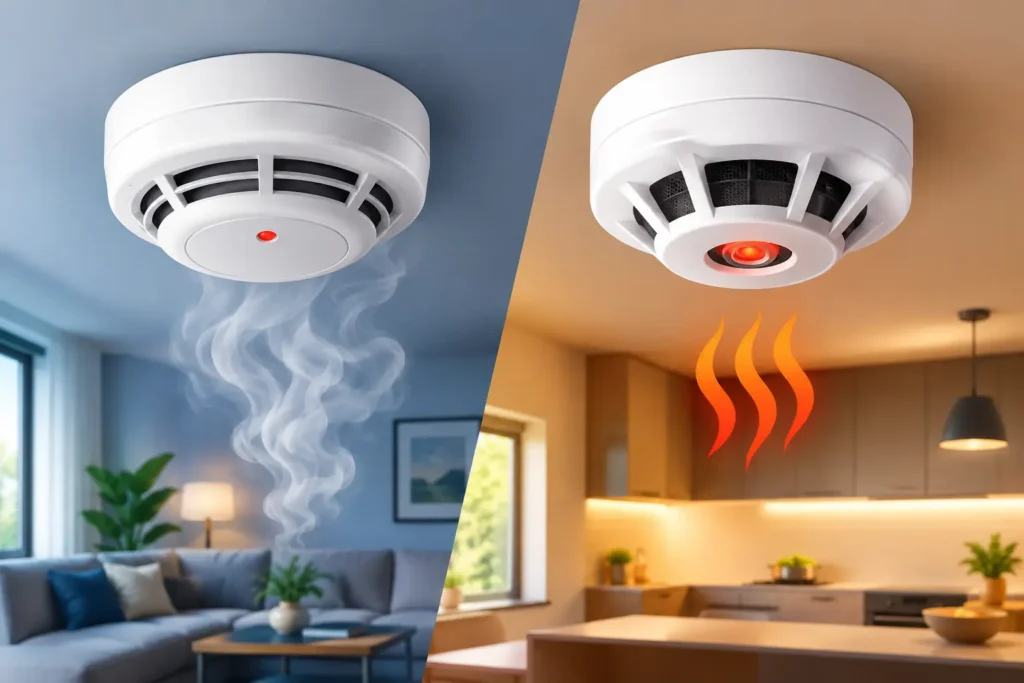
A detector mounted in the wrong location can create a frustrating choice: frequent false alarms that get ignored, or delayed warning when seconds matter. Understanding smoke versus heat detectors helps homeowners, business owners, and facility managers make decisions that support earlier evacuation, dependable fire alarm performance, and code compliance.
The short answer is that smoke detectors and heat detectors serve different purposes. Smoke detection is usually the primary life-safety tool because smoke often reaches dangerous levels before a fire creates enough heat to activate a heat detector. Heat detectors are valuable in specific environments where smoke detection may be unsuitable or prone to unwanted alarms. In many professionally designed systems, the right answer is not one or the other. It is both, placed where each device performs best.
Smoke Versus Heat Detectors: The Core Difference
A smoke detector responds to particles in the air created by combustion. Depending on its technology, it may detect visible smoke, smaller particles from fast-burning flames, or a combination of both. Because smoke can spread through a room and into hallways before temperatures rise substantially, smoke detectors typically provide the earliest warning for people sleeping, working, or moving through a building.
A heat detector responds to temperature. Some activate when the surrounding air reaches a fixed temperature, often around 135°F or 194°F depending on the application. Others respond when the temperature rises unusually fast. These are commonly called rate-of-rise heat detectors.
That distinction matters. By the time a heat detector activates, a fire may already be well established. Heat detection is therefore generally not a replacement for smoke alarms in bedrooms, hallways, offices, and other occupied areas. Instead, it is an added layer of protection in places where normal activity produces steam, dust, fumes, or airborne particles that could trigger smoke alarms unnecessarily.
Where Smoke Detectors Make the Most Sense
For most homes, smoke alarms belong inside every sleeping area, outside each separate sleeping area, and on every level of the home, including the basement. Interconnected alarms offer an important advantage: when one alarm senses danger, the others sound as well. That gives everyone in the home a better chance to hear the warning, even if the fire begins far from their bedroom.
Smoke detectors are also central to commercial fire alarm systems. Offices, corridors, common areas, classrooms, healthcare spaces, and many other occupied environments may require smoke detection based on the building’s use, layout, and applicable fire code. A professionally monitored fire alarm system can send an alarm signal to a central station when the system activates, helping ensure a prompt response even when the building is unoccupied.
There are trade-offs. Smoke detectors should not be placed too close to cooking appliances, bathrooms with heavy steam, or other areas that regularly generate airborne contaminants unless the device type and placement are specifically designed for that environment. A detector that alarms repeatedly during normal activity can lead people to disable it, remove its battery, or stop taking alarms seriously. None of those outcomes improves safety.
Photoelectric and Ionization Smoke Detection
Smoke alarms use different sensing methods. Photoelectric smoke detectors are generally effective at recognizing larger smoke particles that can occur in slow, smoldering fires. Ionization alarms tend to respond quickly to smaller particles often associated with fast-flaming fires. Dual-sensor units combine both methods.
For many residential applications, a photoelectric or dual-sensor approach provides practical protection. In commercial settings, the selection may also involve the fire alarm control panel, local code requirements, ceiling height, airflow, occupancy, and the need for system supervision. The best device is not simply the one with the most features. It is the one selected and installed for the risks in that specific space.
Where Heat Detectors Are a Better Fit
Heat detectors are commonly used in kitchens, garages, utility rooms, mechanical areas, laundry rooms, workshops, and certain storage or industrial spaces. These areas can contain dust, exhaust, humidity, steam, or routine temperature changes that make smoke detection less practical.
For example, a garage may include vehicle exhaust and dust from tools or stored materials. A commercial kitchen produces heat, steam, and cooking byproducts throughout the day. Installing an ordinary smoke detector in these locations may result in nuisance alarms that interrupt operations and reduce confidence in the system. A properly selected heat detector can provide fire detection without reacting to every normal condition in the room.
Heat detection also has limits. It should not be used as the sole warning device in a bedroom, living room, or occupied office simply because it is less likely to alarm accidentally. The lower likelihood of nuisance alarms comes with slower detection in many fire scenarios. That is a meaningful trade-off when people may need time to escape.
Fixed-Temperature vs. Rate-of-Rise Heat Detectors
A fixed-temperature heat detector activates after the ambient temperature reaches a set threshold. It can be appropriate where high heat is a clear sign of abnormal conditions.
A rate-of-rise detector responds to a rapid increase in temperature, even if the room has not yet reached its fixed alarm temperature. This can offer faster notification when a fire grows quickly. However, a location that experiences frequent fast temperature swings during normal operations may need a different approach. Equipment selection should account for how the space is actually used, not just what the room is called on a floor plan.
Fire Detection Is About Placement, Not Just Equipment
A high-quality detector cannot perform as intended if it is blocked, poorly located, incorrectly wired, or left unmaintained. Ceiling height, HVAC airflow, open floor plans, cooking areas, doors, beams, and equipment all affect how smoke and heat move through a space.
In a home, smoke alarms are often ceiling-mounted because smoke rises. They should be positioned according to manufacturer instructions and applicable requirements, with attention to nearby vents, fans, and kitchens. A large home, a home with multiple levels, or a residence with family members who are young, elderly, hard of hearing, or medically vulnerable may benefit from a more tailored alarm and monitoring plan.
For a business, placement decisions can become more complex. A warehouse with high ceilings does not behave like a small retail office. A restaurant kitchen has different detection needs than a medical office, apartment building, or manufacturing facility. Fire alarm requirements may be determined by occupancy type, local authority requirements, insurance considerations, and the building’s existing suppression and notification systems.
Professional design also considers what happens after detection. An alarm must notify people inside the building with appropriate audible and visual devices when required. The system may need to release doors, control ventilation equipment, recall elevators, interface with fire sprinkler monitoring, or send a supervised signal for emergency response. These connected functions are why commercial fire protection should be evaluated as a complete system rather than a collection of individual devices.
Do You Need Carbon Monoxide Detection Too?
Smoke and heat detectors do not detect carbon monoxide. Carbon monoxide is a colorless, odorless gas that can be produced by fuel-burning appliances, fireplaces, vehicles, generators, and malfunctioning heating equipment. It requires a separate carbon monoxide alarm.
Homes with attached garages, fireplaces, gas appliances, or other fuel-burning equipment should consider carbon monoxide detection in the appropriate locations. In commercial facilities, the need depends on the building use, equipment, and applicable codes. A fire and life-safety assessment can identify whether CO detection should be part of the plan.
Testing and Maintenance Protect Detector Performance
Every detection device needs regular attention. Homeowners should test alarms according to the manufacturer’s instructions, keep devices free of dust and paint, and replace batteries when required. If a smoke alarm chirps, activates without an obvious cause, or has reached the manufacturer’s recommended replacement age, do not ignore it.
Commercial systems require a more structured maintenance approach. Inspection, testing, and servicing help confirm that initiating devices, alarm panels, backup power, notification appliances, and monitoring communication paths are functioning as intended. Documentation matters, especially for businesses that must demonstrate compliance to inspectors, insurers, or property managers.
Never remove batteries or disconnect a detector to stop a nuisance alarm. Address the cause instead. It may be as simple as cleaning, battery replacement, relocation, or selecting the right detector type for the area. In other cases, it may reveal a wiring issue, aging device, or system condition that needs professional service.
Choose Detection That Matches Your Real Risks
The practical choice between smoke and heat detection begins with one question: what conditions are normal in this room, and what warning do people need if a fire starts? Bedrooms and living spaces need early smoke warning. Garages, kitchens, and mechanical areas may call for heat detection or a carefully selected combination of devices. Commercial properties often need a professionally engineered approach that accounts for code, operations, and the building’s life-safety systems.
For more than 30 years, ADP Security Systems has helped South Carolina homes and businesses build protection around real-world needs, with professional installation, ongoing support, and monitored life-safety solutions. A thoughtful detector plan does more than reduce false alarms. It gives the people in your care the warning and support they need when every moment counts.