Improving Retail Store Safety With Smart Locks
October 19, 2026
Integrated Life Safety Solutions for Modern Homes
October 21, 2026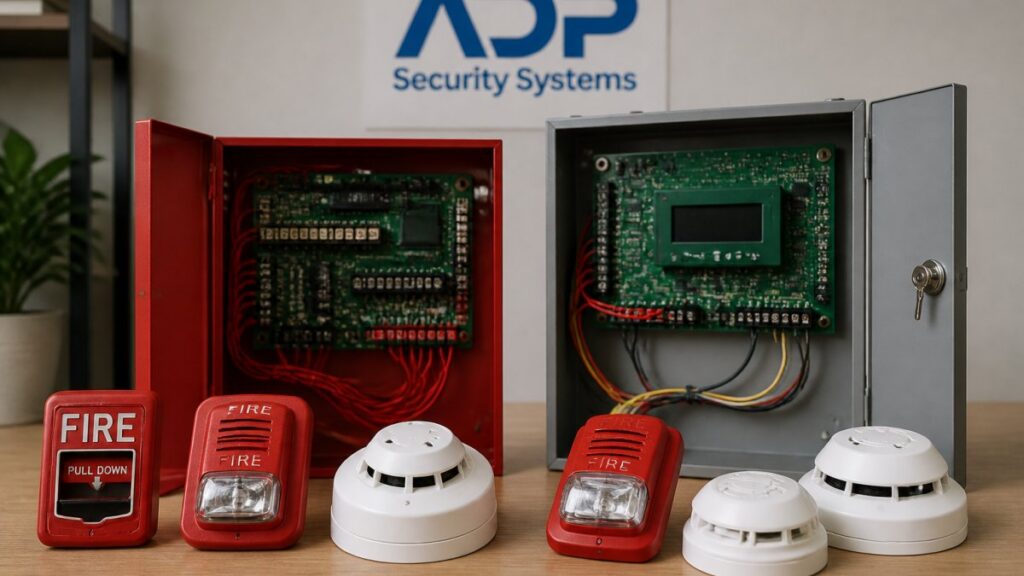
Table of Contents
- How Conventional Fire Alarm Systems Work
- How Addressable Fire Alarm Systems Work
- Key Differences: Detection Zones vs Individual Device Identification
- Conventional Fire Alarm System Zones and Capacity
- Addressable Fire Alarm System Cost and Scalability
- Fire Alarm System Installation and Maintenance Requirements
- Choosing the Right System for Your Building
- Frequently Asked Questions
Last Updated: October 19, 2026
How Conventional Fire Alarm Systems Work
A conventional addressable fire alarm system divides a building into detection zones, each wired to the main control panel on a single circuit.
If a storage room detector triggers, the panel announces “Zone 3 alarm” without pinpointing the location, so a technician or firefighter must search the zone for the source.
Components are basic, smoke detectors, heat detectors, manual call points, and notification devices (bells, horns, strobes) wired to zones.
Conventional systems work best in buildings with simple layouts where a single zone covers a manageable area. If your building is small enough that firefighters can search a zone quickly, the lack of precise device location rarely causes problems in practice.
How Addressable Fire Alarm Systems Work
An addressable fire alarm system identifies each device individually.
Instead of “Zone 3 alarm,” the panel shows “Smoke detector, 3rd floor, Room 312,” so firefighters know immediately where to look.
Addressable systems use loop wiring: one or two loops can serve an entire building.
The trade-off is complexity: addressable panels cost more, programming requires more skill, and installation takes longer because each device needs an address.
Addressable systems turn your fire alarm into an intelligent sensor network. You don’t just know there’s a fire; you know exactly where it is and what devices are healthy or failing.
Key Differences: Detection Zones vs Individual Device Identification
The fundamental difference is how each system reports alarms: conventional by zone, addressable by device.
Conventional approach: Multiple detectors share one circuit and zone identity. When any detector activates, the entire zone alarms, and the panel cannot distinguish which device triggered.
Addressable approach: Each detector has a unique address.
This difference affects every aspect of operation:
- Alarm response time: Addressable systems send responders directly to the fire source, not a zone entrance.
- False alarm investigation: Addressable systems show which device triggered; conventional systems require inspecting every device in the zone.
- System diagnostics: Addressable systems continuously monitor device health; conventional systems only know if a circuit works.
For small, simple buildings, the zone-based approach works fine. For larger or complex buildings, device-level identification is essential.
Conventional Fire Alarm System Zones and Capacity
Conventional systems organize buildings into detection zones, each a separate circuit with its own detectors and notification devices.
Wiring layout determines zone boundaries, since all detectors in a zone connect to the same circuit.
Zone design requires planning: poor layout creates large search areas, while good design keeps sections small enough to search quickly.
As buildings grow, the zone-based approach becomes less practical.
Addressable Fire Alarm System Cost and Scalability
Most comparisons stop at the control panel’s sticker price, the least useful number. The real comparison is lifecycle cost: purchase, installation labor, inspection and testing, maintenance and troubleshooting, expansion, and replacement. On that basis, the crossover point often differs from the initial quote.
What actually drives the cost difference
- Control panel and loop cards. Addressable panels carry more processing, more memory for device labels, and network or remote-annunciation options. Conventional panels are simpler and cheaper per zone, but you need more as zone counts climb.
- Wiring and raceway. Conventional systems run home-run circuits from each zone back to the panel. Addressable systems use a signaling line circuit (SLC) loop that can serve hundreds of devices on one or two pairs of wires. On large or spread-out buildings, the loop architecture can reduce copper, conduit, and labor, sometimes substantially.
- Device cost. Addressable detectors and modules cost more per device than conventional equivalents. That per-device premium is real and should be counted honestly.
A practical way to frame the comparison
Rather than asking which system is cheaper, ask which cost curve is flatter over your building’s service life:
- Small, simple buildings with stable occupancy, conventional usually wins on lifecycle cost, since low device counts mean addressable diagnostics don’t save enough labor to offset higher device and panel costs.
- Larger or more complex buildings, addressable tends to win as loop wiring, faster testing, device-level troubleshooting, and cheaper expansion compound over time.
- Buildings expected to change, renovations, tenant fit-outs, and additions favor addressable, where adding a device is cheap and doesn’t require redesigning zones.
Codes, standards, and approval affect the math
Cost comparisons are only valid within your building’s code framework. In the United States, NFPA 72 governs installation, testing, and maintenance, and NFPA 101 governs egress and occupancy. Local jurisdictions adopt and amend these codes, and the authority having jurisdiction (AHJ), typically the fire marshal, has final say on what is acceptable.
That matters for cost because:
Get a Free Security Assessment →
- Some occupancies and building sizes trigger requirements that push you toward addressable systems, such as specific device identification or networked annunciation.
- Some jurisdictions require acceptance testing and documentation that addressable system reports satisfy more easily.
- Retrofit and renovation work may be subject to current code even when the rest of the building is grandfathered, changing the economics of keeping a conventional panel.
Confirm requirements with your AHJ and a licensed fire protection professional before budgeting. A design that is cheaper on paper but rejected at plan review is the most expensive option available.
Do not choose a system on initial price alone. A conventional system sized for today’s building can become a costly retrofit when the building grows or the occupancy changes. Ask your contractor to model the cost at current size, at a realistic expansion scenario, and at end of life.
Scalability in practice
Addressable scalability is real but not unlimited: a single SLC loop has a maximum device count and wire length set by the manufacturer and code, so large buildings use multiple loops, loop cards, and sometimes networked panels. Conventional scalability is bounded by panel zone capacity and each zone’s practical search area. The honest question isn’t which scales better, but which architecture keeps the cost of the next 20 percent of growth lowest.
Fire Alarm System Installation and Maintenance Requirements
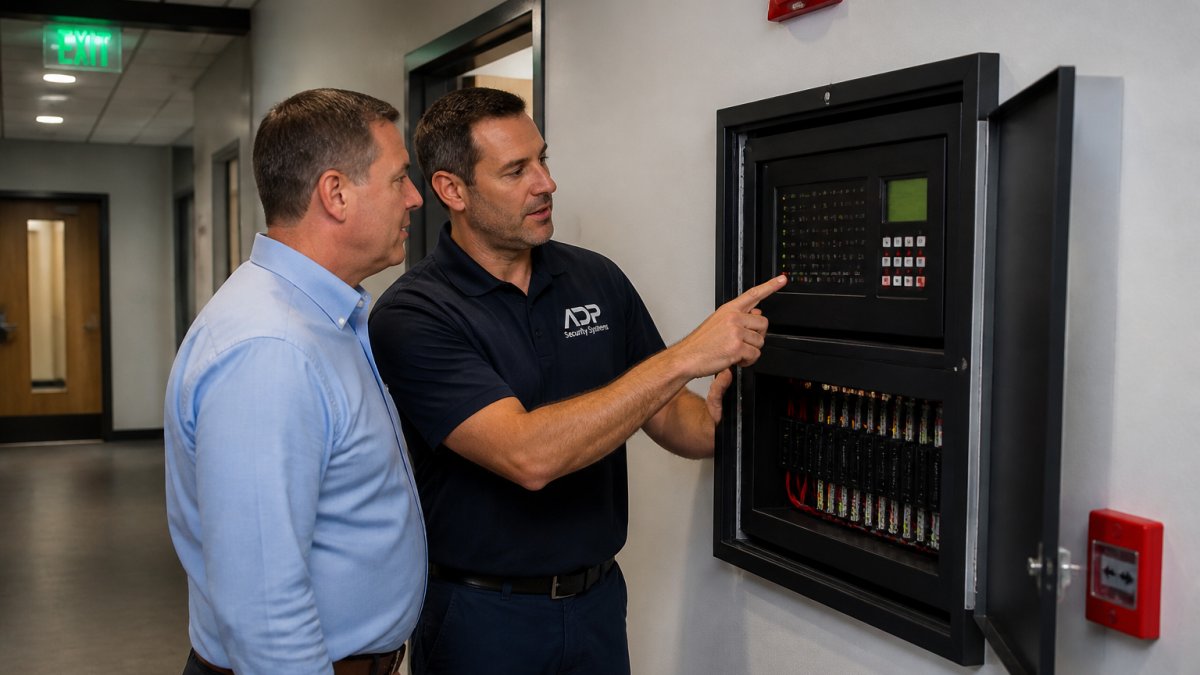
Addressable installation requires more expertise: the installer runs loop wiring, assigns addresses, programs device locations into the panel, and tests two-way communication with each address.
Maintenance differs too. Conventional systems require periodic testing of each zone circuit and visual detector inspection.
Both require annual professional testing and certification, regular detector cleaning and battery replacement, and code compliance inspections. The difference is diagnostic depth and troubleshooting speed.
At ADP Security Systems, we handle installation and maintenance for both system types across South Carolina.
Choosing the Right System for Your Building
Square footage alone is a weak decision rule. Two 8,000-square-foot buildings can have very different needs depending on layout, occupancy, ceiling height, expected churn, and what the AHJ will accept. Score the building against the factors that actually change the answer, then confirm against code and lifecycle cost.
A practical decision framework
Score each factor for your building. The pattern of answers, not any single number, points to the right architecture.
| Factor | Leans conventional | Leans addressable |
|---|---|---|
| Floor area | Small, single-story, compact footprint | Large, multi-story, or spread across wings |
| Layout | Open, simple, few compartments | Many rooms, corridors, tenant suites, or complex egress paths |
| Occupancy | Low occupant load, stable use | High occupant load, public assembly, sleeping, or healthcare occupancies |
| Device count | Low, a handful of detectors per zone | High, many devices where zone search areas would be large |
| Future change | Little expected renovation or expansion | Renovations, tenant fit-outs, or additions are likely |
| Operational needs | Local alarm and basic monitoring | Remote monitoring, integration with building systems, detailed diagnostics |
| Maintenance capacity | In-house staff comfortable with zone-level troubleshooting | Staff or contractor able to use device-level diagnostics |
| Budget horizon | Initial cost is the binding constraint | Lifecycle cost and expansion cost matter more than sticker price |
Mostly left column: conventional is likely right. Mostly right column: addressable is likely justified. Mixed results mean the building is near the crossover point, use the tie-breakers below.
Tie-breakers when the score is mixed
- Device density. If covering the space well requires many detectors, addressable systems often become more cost-effective because loop wiring and device-level diagnostics reduce labor over the system’s life.
- Search area. If a zone alarm would send responders into a large or confusing area, device-level identification has real operational value.
- Expected churn. If the building will be renovated or re-tenanted, addressable systems make each change cheaper and less disruptive.
Codes, standards, and the approval process
System selection is also a code and approval question. NFPA 72 governs fire alarm installation, testing, and maintenance, and NFPA 101 governs life safety and egress. Local jurisdictions adopt and amend these codes, and the AHJ, usually the fire marshal, reviews and approves the design.
A practical sequence:
- Confirm the occupancy classification and any local amendments that apply to your building.
- Ask the AHJ early whether the occupancy, size, or use triggers requirements that favor or require addressable systems.
- Have a licensed fire protection professional prepare the design and submittal.
- Plan for acceptance testing and documentation, addressable systems typically produce more detailed test records, which can simplify sign-off.
- Keep the approval path in the budget. Plan review, permitting, and inspection are real costs and real schedule items.
Do not treat code as a box to check after the system is chosen. It is one of the inputs that determines which system is appropriate.
Migration and retrofit planning
Many buildings are replacing or extending an existing system, which changes the decision.
- Reuse of existing wiring. Conventional systems often reuse existing zone wiring when replacing a panel. Addressable systems may reuse wiring if it meets the manufacturer’s loop requirements and code, but this must be verified, not assumed.
- Phased upgrades. Addressable systems can sometimes be installed in phases alongside a legacy system before cutover; conventional replacements are usually all-or-nothing.
- Downtime. Cutover planning matters in occupied buildings. Addressable systems allow more granular phasing but require more commissioning time per device.
- When to replace rather than extend. If a conventional panel is at end of life, zone capacity is exhausted, or occupancy has changed enough that zone-level identification is inadequate, replacing with addressable is often the better long-term decision.
Operational and false-alarm considerations
Device-level identification changes how nuisance alarms are handled. With addressable systems, teams see which specific device activated and why, shortening investigation and distinguishing a real event from a dirty or faulty detector. Conventional systems require physically checking devices in the zone.
A note on professional judgment
The framework above is a starting point, not a substitute for a licensed fire protection professional and the AHJ. Local amendments, occupancy specifics, and building conditions can change the answer. Enter that conversation with the right questions, a realistic lifecycle budget, and a clear view of how the building will change, so the system still fits in ten years, not just on commissioning day.
Frequently Asked Questions
What is the main difference between conventional and addressable fire alarm systems?
Conventional systems report alarms by detection zone, meaning they tell you which zone detected fire but not which specific device triggered the alarm. Addressable systems identify individual devices and pinpoint the exact location of the alarm within seconds. This difference affects how quickly responders locate the fire and how the system scales with building size.
How much does an addressable fire alarm system cost compared to conventional?
Conventional systems typically have lower upfront hardware costs. Pricing depends on building size, device density, and installation complexity; contact ADP Security Systems for a custom quote.
Which system is better for a small commercial building?
For small commercial buildings, a conventional system often makes financial sense due to lower initial costs and simpler wiring. However, if your building has multiple floors, complex layouts, or you value precise device identification for faster emergency response, an addressable system may justify the additional investment. A professional assessment of your specific layout and occupancy will determine the best fit.
Are conventional fire alarm systems harder to maintain than addressable systems?
Conventional systems are generally simpler to troubleshoot because they have fewer components and programming requirements. Addressable systems require more detailed diagnostics and commissioning but offer better fault-finding capabilities once installed. Both benefit from regular professional maintenance schedules. ADP Security Systems provides customizable maintenance plans tailored to either system type to ensure reliability and compliance.
Can I retrofit an older building with a new fire alarm system without major rewiring?
Retrofit feasibility depends on your building’s existing wiring and condition. Conventional systems may work with some existing infrastructure, while addressable systems can sometimes be installed with fewer new runs because they use loop circuits more efficiently. An on-site assessment is essential to determine whether you can work with existing conduit or if new wiring is necessary. Contact ADP Security Systems for a professional evaluation of your property’s retrofit options.