


9 Reasons Your Home Security System Keeps False Alarming
November 5, 2026
How to Secure a Warehouse Against Unauthorized Entry
November 6, 2026
Last Updated: November 5, 2026
Quick Summary
Medical alert systems for couples living together usually come as a shared dual-user plan where both partners get their own button or wearable under one subscription, with two separate medical history profiles on file. The monitoring center assigns each device to a specific user so it pulls up the right person’s health information. Dual plans typically discount the second subscription rather than charging double.
- A single-user plan covers one person with one device and one emergency contact list.
- Fall detection is usually an add-on with an extra monthly fee and can miss a slow slide from a chair.
- In-home pendants only work within a few hundred feet of the base station, less through walls and floors.
- Most providers expect one base station per household; adding a second can cause missed signals.
- Ask whether the quoted dual-plan rate is locked for the term or subject to annual increase.
Table of Contents
- Dual-User vs Single-User Medical Alert Systems: What Changes for Couples
- Medical Alert Systems for Two People: Side-by-Side Comparison
- Medical Alert Systems for Seniors With Fall Detection
- Wearable Medical Alert Devices: Pendants, Wrist Buttons and Range Limits
- Medical Alert Systems for Seniors With No Monthly Fee: What Actually Exists
- In-Home vs Mobile Alert Options for Couples, and How They Pair With Existing Security
- Costs, Contracts and HSA/FSA Eligibility for Two-User Plans
- Get a Free Security Assessment for Your Two-Person Household
- Frequently Asked Questions
Dual-User vs Single-User Medical Alert Systems: What Changes for Couples
Two people in one household do not need two separate accounts, and that is the single most useful fact about medical alert systems for couples living together. Most providers sell a shared plan where both partners get their own button or wearable under one subscription. The difference between a single and dual plan comes down to how the monitoring center identifies who pressed the button.
A single-user plan covers one person with one device and one emergency contact list. A dual-user plan covers two people, often with a discount on the second subscription, and keeps two separate medical history profiles on file.
That second profile is the part couples underestimate. Shared plans handle this by assigning each device to a specific user. Can medical alerts call family explains how caregiver contacts are handled for each user.
How Monitoring Centers Tell Two Users Apart
Your medical alert setup can also route caregiver notifications differently for each person.
Medical Alert Systems for Two People: Side-by-Side Comparison
The right dual-user system depends on whether both partners stay home, both go out, or one does each. Here is how the main options compare for two-person households.
| System | Best For | Dual-User Support | Standout Feature |
|---|---|---|---|
| ADP Security Systems | Couples wanting install, monitoring and home security in one | Two profiles, one account | 24/7 monitoring plus 4G and GPS medical alerts |
| MobileHelp | Couples who want mobile GPS at a lower monthly rate | Dual plans available | No equipment purchase fees |
| Bay Alarm Medical | Couples who want a dedicated two-person bundle | Two-person bundle | No activation fees, month-to-month |
| Medical Care Alert | Couples who prioritize trained dispatchers | Two profiles | EMT/EMD-certified operators |
| ADT Health | Couples already using home security | Two profiles | Integration with security ecosystem |
That is where ADP Security Systems fits: over 30 years serving South Carolina, 24/7 alarm monitoring, and nationwide GPS and 4G wireless medical alert capability.
Medical Alert Systems for Seniors With Fall Detection
Fall detection is the feature couples ask about most, and it works differently than most people expect. A fall-detection pendant uses motion sensors to spot a sudden drop and then checks whether the wearer is still upright.
That automatic call matters in a two-person home. If one partner falls in the bathroom and the other is asleep or outside, no one presses anything. The device does it.
Two caveats to know before you buy. Fall detection is usually an add-on with an extra monthly fee, and it is not perfect. Our medical alert fall detection options pair the sensor with two-way voice so the operator can confirm what happened.
Wearable Medical Alert Devices: Pendants, Wrist Buttons and Range Limits
Wearables come in two forms. Pendants hang on a cord and sit close to the chest, which makes them easy to grab and less likely to be left on a nightstand. Wrist buttons look like a watch and suit people who dislike anything around the neck.
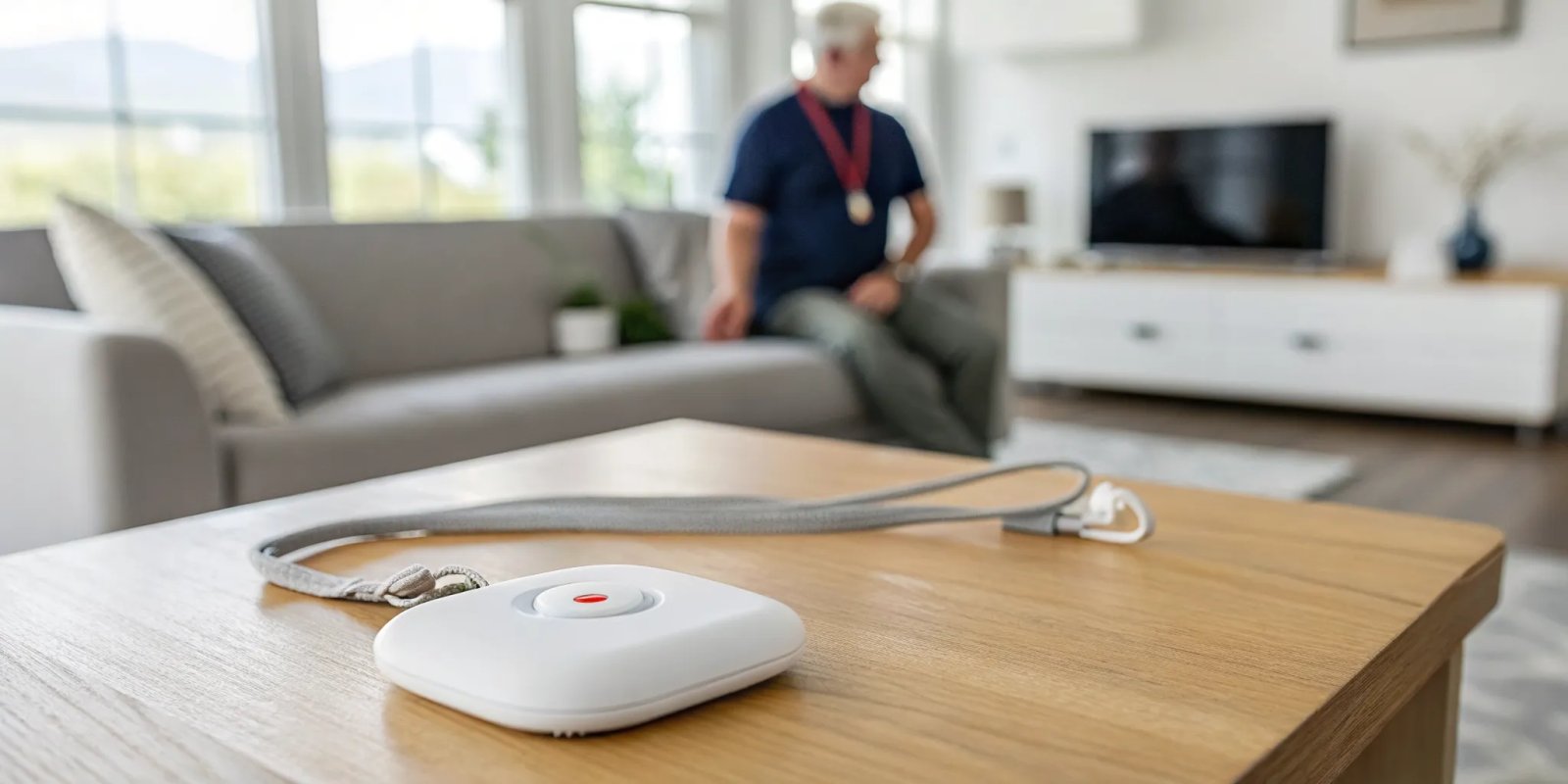
Range is where in-home wearables trip people up. A pendant paired to a base station only works within a set distance of that base, often a few hundred feet, and walls and floors cut that down.
Waterproof ratings matter too. If you are weighing form factors for each partner, this bracelet versus pendant comparison covers how each wears day to day.
Medical Alert Systems for Seniors With No Monthly Fee: What Actually Exists
Free medical alert service with no monthly fee is rare, and the options that exist come with trade-offs. A monitoring subscription pays for the call center, the cellular connection and the staff on the other end.
What you will find instead:
- One-time-purchase devices that call a preset family number rather than a monitoring center, with no ongoing fee but no 24/7 operator either
- Upfront equipment bundles where the hardware is paid in full but monitoring still carries a monthly charge
- Assistance programs that may help cover the cost for eligible households, which vary by program and location
Be skeptical of any offer promising full professional monitoring at zero cost. If a family member is the only responder, the system depends on that person being reachable.
In-Home vs Mobile Alert Options for Couples, and How They Pair With Existing Security
The best setup for many couples is a mix: an in-home base station for the partner who stays put, and a mobile GPS device for the one who drives, gardens or walks.
Mobile units use cellular connectivity and GPS location tracking, so the monitoring center knows where the alert came from. In-home units rely on a base station and either a landline or cellular link, with battery backup for power outages.
How the Two Types Behave in a Two-Person Home
An in-home pendant only reaches the monitoring center through its base station, so its useful range is the base station’s range, often a few hundred feet and less through walls and floors.
Get a Free Security Assessment →
A mobile unit carries its own cellular link and GPS, so it works anywhere there is cell coverage. The trade-off is battery life and charging routine: a mobile device left on the charger is not protecting anyone.
Pairing With an Existing Home Security System
Here is the compatibility angle most guides skip. If you already have a home security system, ask whether the medical alert can run on the same account and app.
The questions to ask your provider before you buy:
- Does the medical alert panel share the same cellular communicator as the security panel, or does it need a separate line?
- Can both devices report to the same monitoring center, and does that center handle medical and burglary alerts under one account?
- Does the mobile app show medical alert status alongside alarm status, or are they two separate logins?
We install both, so we can tell you whether your existing panel supports it. If you are still deciding between the two alert types, this mobile versus in-home comparison lays out when each one protects better.
Preventing Interference When Two Devices Share a House
Two base stations or two pendants in close proximity can create problems that single-user guides never mention. The common patterns:
- Base station crowding. Two in-home bases in one house can compete for the same phone line or cellular signal. Most providers expect one base per household; adding a second is usually unnecessary and can cause missed signals.
- Pendant pairing confusion. Each pendant must be paired to the correct base and user profile. If both pendants are activated near the same base during setup, confirm in the app or with the monitoring center that each device ID maps to the right person.
- Wi-Fi and cordless phone overlap. Some base stations use the same frequency bands as cordless phones and Wi-Fi routers. Keeping the base a few feet from the router and the phone base reduces dropped signals.
Watch out: if a pendant tests fine in one room but fails in another, the problem is usually range or interference, not a dead battery. Test each device in the rooms each partner uses most before you rely on it.
Costs, Contracts and HSA/FSA Eligibility for Two-User Plans
Pricing for two-user plans depends on quantity, dates, and delivery; visit ADP Security Systems’s website for current prices or a quote. A few structural facts hold across providers:
- Dual plans usually discount the second subscription rather than charging double
- Fall detection typically adds a monthly fee per device
- Activation fees vary, and some providers waive them
How Dual-User Pricing Actually Stacks Up
The pricing logic is consistent enough to plan around. A single in-home plan typically covers one base station and one wearable under one monitoring subscription.
Mobile plans work differently. Each mobile device carries its own cellular line and GPS radio, so a two-person mobile plan is closer to two subscriptions with a multi-line discount.
Watch out: some advertised dual-plan rates assume a long contract term.
Contract Terms to Read Before You Sign
Three clauses decide whether a dual plan is flexible or sticky:
- Cancellation policy. Month-to-month plans usually cancel with notice, but some require 30 days and a final billing cycle. Term contracts may charge a termination fee tied to the remaining months.
- Equipment ownership. Leased equipment usually must be returned at cancellation, and lost pendants can carry a replacement charge. Purchased equipment is yours but is not refundable once activated.
- Price locks. Ask whether the quoted rate is locked for the term or subject to annual increase. A dual discount that expires after year one changes the math.
HSA and FSA Eligibility: The Mechanics
- Get a written prescription or letter of medical necessity from a physician that names the monitoring service, not just the hardware.
- Confirm with your plan administrator that the service qualifies as a qualified medical expense under your plan documents.
- Keep the prescription, the receipts and the plan confirmation together in case of an audit.
What Drives the Final Number
For a two-person household, the variables that move the bill most are the number of mobile devices, whether fall detection is added per device, and the contract term. In-home-only setups are the least expensive to run because the shared base station carries both users. Mobile and GPS capability raises the monthly rate, and it raises it twice when both partners carry a device.
Get a Free Security Assessment for Your Two-Person Household
Two people, two sets of health needs, one household. The setup that works is the one built around how each partner actually lives, not a generic bundle.
ADP Security Systems has served South Carolina for over 30 years. We offer 24/7 alarm monitoring, nationwide GPS and 4G wireless medical alert capability, and customizable maintenance schedules.
Get started with ADP Security Systems and a free security assessment for your household.
Frequently Asked Questions
Can two people use one medical alert system?
Yes, but the setup matters. Some providers sell a two-person bundle where one base station serves both users, each with a separate wearable pendant or wrist button, and the monitoring center keeps a distinct medical history profile for each person. Others require two separate systems. Ask the provider whether the plan includes dual-user coverage or whether the second user is billed as an add-on, because that difference drives the monthly subscription cost.
Do couples need separate medical alert devices?
In most cases, yes. A single wearable pendant only helps the person wearing it, so if the other partner falls in another room there is no button to press. Dual-user plans solve this by pairing two wearables with one base station or monitoring account. Couples where one partner has a higher fall risk sometimes start with one mobile device and one in-home button, then add coverage later as needs change.
Do medical alert systems for couples include fall detection for both users?
Not always. Fall detection is usually an optional add-on with an extra monthly fee per user, so a two-person plan can double that charge. Check whether the sensor is built into the pendant or wrist button, how it distinguishes a fall from setting the device down, and whether it works with the mobile unit as well as the in-home base station. Confirm both wearables are fall-detection capable before you sign.
How much does a medical alert system for two people cost?
Pricing depends on quantity, dates, and delivery; visit ADP Security Systems’s website for current prices or a quote.
Which medical alert system is best for couples living together?
The right fit depends on how active each partner is. Couples who stay close to home do well with an in-home base station plus two waterproof pendants and wall-mounted buttons in the bathroom. Couples who drive, garden or travel need mobile units with GPS location tracking and cellular connectivity. Prioritize a monitoring center that keeps separate medical history profiles, offers two-way voice communication, and has a clear cancellation policy before you commit.


